� History � About
Sandakan � Accommodations � Getting There �
Billed as the �Gateway to Borneo�s Wildlife, Sandakan
is known as the gateway for ecotourism destinations in Sabah, such as the
Sepilok Orang Utan Sanctuary, Turtle Islands Park, Kinabatangan River and
Gomantong Caves.

History
Sandakan was ruled by the Sultan of Sulu from the Philippines in the 18th
century. William Clarke Cowie, in the early 1870s, a Scottish adventure and
engineer, delivered guns and ammunitions to the Sultan of Sulu.

He did this for protecting territory of the Sultan against the Spanish
conquerors. In return, Cowie was granted permission by the Sultan to set up
base on Pulau Timbang, in Sandakan Bay, where a small Suluk village existed.
Cowie called his base Sandakan, which in Tausug (Sulu) means "the place that
was pawned", but it soon came to be known as "Kampung German" after the large
number of Germans who also set up posts there. An Austrian, Baron von
 Overbeck
acquired the lease from the Sultan in 1878, and this was later sold to Alfred
Dent, a Hong Kong-based publisher. It was only later that William Pryer
appeared on the scene as the new British Resident. When Kampong German was
accidentally razed to the ground on 15 June 1879, William B. Pryer, decided
not to rebuild the village but to move to Buli Sim Sim on 21 June 1879. He
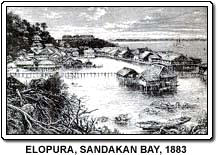
named his new settlement Elopura, which means Beautiful City'. A few years
later, the name was changed back to Sandakan. In 1883, the capital of the
British North Borneo Company was moved from Kudat to Sandakan. Overbeck
acquired the lease from the Sultan in 1878, and this was later sold to Alfred
Dent, a Hong Kong-based publisher. It was only later that William Pryer
appeared on the scene as the new British Resident. When Kampong German was
accidentally razed to the ground on 15 June 1879, William B. Pryer, decided
not to rebuild the village but to move to Buli Sim Sim on 21 June 1879. He
named his new settlement Elopura, which means Beautiful City'. A few years
later, the name was changed back to Sandakan. In 1883, the capital of the
British North Borneo Company was moved from Kudat to Sandakan.
In the early years, Sandakan served as a major port for early settlers to
Sabah, and most Chinese came through this port that once earned the nick-name
of "Little Hong Kong". The trading post developed into a striving little town,
but all business came to an abrupt end when the Japanese invaded Borneo during
WWII. To liberate the town Allied bombers nearly flattened Sandakan towards
the end of the war, and in retaliation the Japanese burnt whatever had
survived the bombings. Sandakan virtually ceased to exist in June 1945. After
WWII, British North Borneo Company relinquished its rights to the British
Crown, and in 1946 under colonial administration Sabah�s capital was moved to
Jesselton (now Kota Kinabalu).
Almost totally destroyed in the air bombings of World War II. Sandakan has
since been rebuilt and became dominant in the timber industry and the foremost
port for the export of timber. It grown into second-largest city and second
most important port, after Kota Kinabalu in Sabah. Timber, once a prime
industry, is now relatively small. Today, it looks certain that tourism will
become increasingly important to the town's future.
About Sandakan
Sandakan is a small compact and captivating town with its very own charm,
friendly people and with its own intriguing history. The main waterfront
street, where the Old Market is situated, is named after Pryer. Being close to
the seas and a large fishing community means there's an abundance of fresh and
fabulous places to eat inexpensive seafood. The Ocean King
 Seafood
Restaurant, built on the water at the Sandy Plain, is a popular seafood eatery
in Sandakan, with a view of the bay that looks out to various nearby islands
in the Sulu Sea. Seafood
Restaurant, built on the water at the Sandy Plain, is a popular seafood eatery
in Sandakan, with a view of the bay that looks out to various nearby islands
in the Sulu Sea.
If you stroll through Sandakan you will find it an intriguing town full of the
colours and scents of Asia. It is a truly bustling town and at times you have
to push your way through crowds and merchandise that spill over into the
sidewalk from the many shops, especially along Pryer Street. Here you find
bargain clothing, cheap watches, jewellers, birds nests, Indonesian
cigarettes, cobblers, preserved ducks and other exotic foods, and much what
could be collected under the term �colonial ware� in a happy profusion. The
shops are mingled with restaurants that serve all sorts of delicious foods,
from 'coto Makassar' over Indian �roti canai� to Chinese fried noodles.
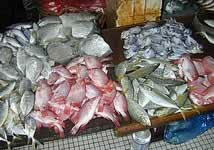 The
Sandakan Central Market is where you find perhaps the most amazing and largest
variety of seafood in Sabah, along with vegetables, spices and oils, cheap
clothing and Indonesian sarongs. The busiest time is on Sunday, when it is
tamu (open market) in Sandakan! In the harbour behind the market you find the
wooden vessels of Suluk fishermen, and those of barter traders from the
Philippines. Located a short walking distance from the centre of town at
Kampung Buli Sim Sim, which is a large water village where the neat wooden
houses are perched on stilts above the sea and reached by plank walkways. The
Sandakan Central Market is where you find perhaps the most amazing and largest
variety of seafood in Sabah, along with vegetables, spices and oils, cheap
clothing and Indonesian sarongs. The busiest time is on Sunday, when it is
tamu (open market) in Sandakan! In the harbour behind the market you find the
wooden vessels of Suluk fishermen, and those of barter traders from the
Philippines. Located a short walking distance from the centre of town at
Kampung Buli Sim Sim, which is a large water village where the neat wooden
houses are perched on stilts above the sea and reached by plank walkways.
In the evening, Sandakan offers a variety of night markets and food stalls
popping up everywhere and selling local charcoal grilled specialities, from
freshly caught fish and squid to chicken wings and 'Western Burgers', all
served with a hot chilly sauce. Local restaurants and coffee shops are open
until late, serving Chinese and Malay cuisine at its best, in convivial and
unpretentious company. But the town gets quiet rather early in the evening;
people in Sandakan get up early in the morning!
Accommodations
There are the four-star Sabah Hotel and the three-star Sandakan Hotel. A
five-star hotel will be built as part of a new urban re-development project -
the Sandakan Harbour Square.
Getting There
There is a highway that cuts across Sabah from the East Coast to the West
Coast, linking the town with Kota Kinabalu that take visitors through a
picturesque countryside.
RELATED LINKS
|
Sights & Places to
Visit in Sandakan
Australian WWII Memorial - Agnes Keith House - The English Tea House - The
Sam Sing Kung Temple - Puh Jih Shih Buddha Temple - St Michaels & All
Angels Church
The dive island
paradise surrounded by a massive coral reef. It's small enough to be
private and far enough to be isolated.
Lankayan is not only for discerning divers but for anyone who appreciates
the tranquility of a paradise island that offers magnificent seascapes
The Turtle
Island Park is a safe haven for the endangered green and hawksbill
turtles. Visitors can go to Selingan Island to witness the rare
opportunity to watch turtle landings and lay their eggs
|
Other Places of
Interest around Sandakan
Agop Batu Tulug - Gomantong Caves - The Sandakan Crocodile Farm
Sepilok Orang
Utan Sanctuary
The centre allows a close-up view of these arboreal creatures and visitors
can observe trainers teaching orphaned or displaced Orang Utan apes to
adapt in their natural habitat.
Labuk Bay Proboscis Monkey Sanctuary
This sanctuary makes an easier and more accessible place for seeing this
handsome monkey only found naturally in Borneo
Kinabatangan River
sustains one of the world's richest ecosystems and is the only place in
Sabah or even Borneo for that matter, that the wildlife is so accessible
|
|
|