|
� The People � Transport � The
Waterfront �
Kota Kinabalu, often simply known as
K.K., is the capital of Sabah and is well known within Malaysia, and to an extent, internationally, as a
tourism getaway and a major gateway
into Sabah and Borneo.
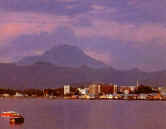 Named
after Mount Kinabalu, which is situated about 90 kilometres east-northeast of
the city, it also features a number of tourist attractions in and around the
city itself. Kota Kinabalu was at one time known as Api-Api (Fire-Fire)
because of the pirates� troublesome habit of repeatedly putting it to the
torch. It was named Jesselton until 1963, after Sir Charles Jessel, one of the
Directors of the British North Borneo Chartered Company. Named
after Mount Kinabalu, which is situated about 90 kilometres east-northeast of
the city, it also features a number of tourist attractions in and around the
city itself. Kota Kinabalu was at one time known as Api-Api (Fire-Fire)
because of the pirates� troublesome habit of repeatedly putting it to the
torch. It was named Jesselton until 1963, after Sir Charles Jessel, one of the
Directors of the British North Borneo Chartered Company.
The town was razed during WWII to prevent the Japanese using it as a base.
After the Japanese takeover of Borneo, it was again renamed Api. At the later
stages of the war, what remained of the town was destroyed again by Allied
bombings as part of the Borneo Campaign in 1945, leaving only three buildings
standing. The new colonial government elected to rebuild Jesselton as the
capital of North Borneo instead of Sandakan, which had also been destroyed by
the war.
Jesselton was renamed Kota Kinabalu on September 30, 1968 with a population of
about 350,000, Kota Kinabalu is now the state capital of Sabah, a thriving
seaport and is the modern gateway to the rest of Sabah.
The People
The city's population today is a mixture of many different races Kadazans,
Chinese, Bajaus and Malays. Most of the Chinese people in the city are Hakkas
and can be found mainly in the Luyang area. The area of Penampang is populated
mainly by Kadazans, while the Bajaus mainly reside in Likas and Sembulan. The
Kadazans here mainly practice Christianity. The Bajaus and Malays follow
Islam. The Chinese are mainly Buddhists or Christians. There is also a sizable
Filipino population in the city.
Most of the Filipino migrants are Suluks coming from the southern parts of
Philippines. There are also a number of Indonesian migrants living around the
city, mostly coming from Flores of the Lesser Sunda Islands. There is a small
population of Indians and Eurasians scattered around the city.
Transport
The internal roads are dual-carriageways and links different parts of the
city. One of the major road here is Jalan Lintas-Jalan Tuaran Bypass, which
together serves almost as a ring road, circling the city and connecting the
districts and suburbs surrounding the city. Regular bus services operate
around the city. Minibuses or vans are also used as an alternative public
transportation. There are two main bus terminals. The Terminal Near Bandaran
Berjaya provides intercity services towards destinations south of the city (Papar,
Tenom, Beaufort, and others) and the newly built Kota Kinabalu (North) Bus
Terminal in Inanam provides intercity buses heading towards destinations north
and north-east of the city - Tuaran, Kudat, Ranau, Sandakan,
Tawau, Semporna, and others
A railway system formerly known as the North Borneo Railway connects Kota
Kinabalu with Tenom and several other towns in between. Today the railway is
known as Sabah State Railway, and it provides daily services for commuters,
travellers, as well as for cargo transportation. A separate company operates
the leisure tour also called the North Borneo Railway, which caters mainly for
tourists.[24] The train station and terminus is located in Tanjung Aru.

Kota Kinabalu International Airport (KKIA) provides flights linking the city
with other domestic and international destinations. It is a secondary hub for
Malaysia Airlines and AirAsia and it consists of two terminals. A major
gateway into Sabah and East Malaysia.[25] Amongst other cities, it serves
flights to Bandar Seri Begawan, Seoul, Tokyo, Hong Kong, Manila, Cebu,
Bangkok, Singapore, Kuala Lumpur, Taipei, and other domestic cities. It is
also a secondary hub for FlyAsianXpress (FAX), which serves flights to smaller
towns and rural areas in East Malaysia.
Kota Kinabalu has two ports: Kota Kinabalu Port and Sepanggar Bay Port.
Kota Kinabalu Ferry Terminal is a passenger ferry terminal located at the
newly built Jesselton Point near the port. It provides ferry and motorboat
services to the nearby islands for tourists as well as for commuters living on
the islands. There are also regular scheduled ferry services to Labuan from
here
The Waterfront
The newly completed Anjung Samudra is already popularly known as 'The
Waterfront' is Kota Kinabalu's one-stop dining and entertainment centre.
Located along Jalan Tun Fuad Stephens, the Waterfront is a popular hangout for
both locals and visitors alike. The Waterfront boasts some of the best
nightclubs in town, and a wide variety of pubs with an excellent choice of
music, drinks and food.

It is a popular meeting place for youngsters to hang out with their friends
and where office workers converge for a beer after work. For tourists, it is
the place to relax while watching the sun going down and eyeing the pretty
ladies that may stroll by. With a good view of the Tunku Abdul Rahman islands
& ships in a distance, it is certainly a very relaxing spot.
There are a few open-air pubs along this stretch of the waterfront that serve
snacks or you may just continue watching the sun set with a glass or two in
hand. Various watering holes such as the popular after-hours hangout, The
Loft, Cock & Bull and Shamrock - all great places to enjoy happy hours as you
watch the sun set over the South China Sea.
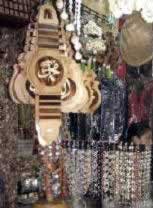 Also
located here next to the main market on the waterfront is the Handicraft
market or known locally as the Filipino Market - where the stalls are owned by
Filipinos who sell a wide variety of handicrafts. From cheap trinkets, which
includes key chains, beaded bracelets, bookmarks, etc to beautiful sarongs and
pareos. Also check out the glistening pearl jewellery. You can purchase loose
pearls or brooches, necklaces and earrings, available at almost every stall
you visit in this vast market. For those with an eye for ornate wooden
carvings, the market has an endless variety of carved crafts, including exotic
wooden masks, picture frames and even stunning wall panels. Not be missed are
the assortment of rattan baskets in all shapes and sizes. The best thing is
that you never know what you might unravel - an authentic sompoton (a
traditional wind instrument), a Murut headhunter's blowpipe, a coconut-shaped
handbag and a wooden-frog that �sings' when you stroke its back with a wooden
stick. The most important tip when visiting the market is to bargain, bargain,
and bargain! Also
located here next to the main market on the waterfront is the Handicraft
market or known locally as the Filipino Market - where the stalls are owned by
Filipinos who sell a wide variety of handicrafts. From cheap trinkets, which
includes key chains, beaded bracelets, bookmarks, etc to beautiful sarongs and
pareos. Also check out the glistening pearl jewellery. You can purchase loose
pearls or brooches, necklaces and earrings, available at almost every stall
you visit in this vast market. For those with an eye for ornate wooden
carvings, the market has an endless variety of carved crafts, including exotic
wooden masks, picture frames and even stunning wall panels. Not be missed are
the assortment of rattan baskets in all shapes and sizes. The best thing is
that you never know what you might unravel - an authentic sompoton (a
traditional wind instrument), a Murut headhunter's blowpipe, a coconut-shaped
handbag and a wooden-frog that �sings' when you stroke its back with a wooden
stick. The most important tip when visiting the market is to bargain, bargain,
and bargain!
RELATED LINKS
|
The Sunday Gaya
Street Fair - Tanjung Aru Beach - Signal Hill - The Atkinson Clock Tower
Lying just 3 to 8
kilometers off the coast off Kota Kinabalu, The Tunku Abdul Rahman Park
comprises of 5 islands surrounded by coral reefs and sea.
TAR Park - The Islands /
TAR Park - Diving
Kiulu River is
suitable for wholesome family fun and for beginners that craves mild
adventure whilst for advanced paddlers we recommend to go to Padas River,
which offers a challenging experience of this sport.
|
Menara Tun Mustapha (Tun Mustapha
Tower) - Sabah State Museum - Sabah State Mosque - K. Kinabalu Wetland
Centre - Tamu Penampang
Built in memory of the great and
legendary Kadazan Warrior Monsopiad, the traditional village gives you an
extraordinary insight into their ancient and rich culture.
Borneo�s only rail service links
Kota Kinabalu at Tanjung Aru to Tenom via Beaufort. This railroad snakes
along the Padas River, giving the passengers a spectacular view of the
Tenom Gorge
|
|
|