� History � People &
Culture � Handicrafts �
History
As early as the 9th century AD., Sabah, then under various chieftains traded
with China and later the Spanish and the Portuguese. During the 15th century,
Sabah was part of the Sultanate of Brunei. In 1704, the Sultan of Brunei ceded
the land east of Murudu Bay (north-east portion of Borneo) to the Sultan of
Sulu as a "gift" in return for the latter's help in settling a civil war.
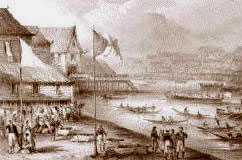 In
1761, the British East India Company, concluded an agreement with the Sultan
of Sulu to allow him to set up a trading post in the region. Attempts to build
a settlement and a military station proved to be a failure due to minimal
foreign interest in this region. Control came again under the Sultanate of
Brunei. the American Consul of Brunei, Claude Lee Moses. Their attempts to set
up a base and settlement also turned out to be a failure due In
1761, the British East India Company, concluded an agreement with the Sultan
of Sulu to allow him to set up a trading post in the region. Attempts to build
a settlement and a military station proved to be a failure due to minimal
foreign interest in this region. Control came again under the Sultanate of
Brunei. the American Consul of Brunei, Claude Lee Moses. Their attempts to set
up a base and settlement also turned out to be a failure due
to financial reasons.
![[Badge of the British North Borneo Company 1882-1948 (North Borneo, Malaysia)]](../tour_malaysia/images/my_nb.gif) The
rights was subsequently obtained by Alfred Dent, an Englishman, in 1881. In
the following year, the British North Borneo Company was formed. In 1888 North
Borneo became a protectorate of Great Britain. Administration and control over
North Borneo remained in the hands of the Company despite being a protectorate
and they effectively ruled until 1942. until the Japanese occupation. The
rights was subsequently obtained by Alfred Dent, an Englishman, in 1881. In
the following year, the British North Borneo Company was formed. In 1888 North
Borneo became a protectorate of Great Britain. Administration and control over
North Borneo remained in the hands of the Company despite being a protectorate
and they effectively ruled until 1942. until the Japanese occupation.
In 1945, after World War II, Sabah became a British Crown Colony. In 1963, it
gained independence and on September 16, 1963, North Borneo together with
Malaya, Sarawak and Singapore formed the Federation of Malaysia and from then
on it became known as Sabah.
People & Culture
The indigenous people of Sabah are friendly and possess rich traditions and
cultures. There are over 30 different ethnic groups and more than 80 local
dialects in the state. The three main indigenous groups of Sabah are the
Kadazan-Dusun, Murut, and Bajau.
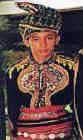 Kadazan-Dusun Kadazan-Dusun
The largest, the Kadazan-Dusun, make up about a third of the population. These
are the prosperous rice producers of Sabah, although in recent times many have
ventured into other trades. Living in the interior plains they are well known
for their unique customs that feature female priestesses called �bobohizan�
presiding over still practiced ancient rituals. One way you can gain insights
into their culture and dances is to visit the
Monsopiad Cultural Village in Kota Kinabalu.
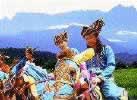 Bajaus Bajaus
Skilled fishermen as well as rice farmers they are also experts in rearing
ponies and water buffaloes. The Bajaus live mainly on the east and west
coasts. East coast Bajaus are sea nomads, coming ashore only to bury their
dead. The West-coast Bajaus are farmers and being dubbed as �The cowboys of
the East�, they are renowned for their horsemanship.
Muruts
Being agriculturists and hunters, they live in the interior region near the
borders of Sarawak and Kalimantan. Once feared for their head hunting, the
Muruts are great hunters with spears, blowpipes and poisoned darts. Many still
reside in their traditional communal longhouses and they are well known for
their elaborate displays of bride-wealth, dancing and feasting.
The Heritage Village located on the Sabah Museum grounds is a good place to
visit for an introduction to these ethnic groups� way of life.
Those who would like to take things a step further and experience life in a
longhouse should visit the Rungus tribe (near Kudat) because they have opened
up their homes to visitors. Longhouses are typically found in the northern and
interior parts of Sabah and each longhouse is divided into apartments for
individual families.
It�s little wonder that an assortment of festivals is celebrated, given the
ethnic diversity here. The people celebrate through music, dance and food that
are uniquely their own. Among the festivals are the Regatta Lepa Semporna
(April), Pesta Keamaatan (May), Pesta Rumbia (July), Pesta Kelapa (September)
and Pesta Jagung (October).
The Chinese are the largest non-indigenous group and are major contributors to
the state�s economic development.

Handicrafts
Like Sarawak, this East Malaysian state�s handicrafts bear the unique stamp of
its many indigenous peoples. In particular look out for beads, hand woven
baskets. Pua-weaving indigenous to the states of Sabah and Sarawak, is
distinguished by ruddy hues and a predominance of
plant and animal motifs
|
|