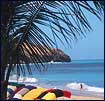
Layang-Layang, an atoll, amongst a
host of other atolls near the famous Spratly group of islands. A new name for
an oceanic atoll once
called "Swallow Reefs".

Layang Layang is an atoll of 13 linked coral reefs situated in the South China
Sea 300km north west of Kota Kinabalu. The island is man-made and was
constructed for the Malaysian Navy and later developed as a dive resort.
Offering absolute isolation, it is rated as a "Big fish and Wall Diving Mecca
of Southeast Asia", to which divers from all over the globe are attracted to.

With its extreme location, the pristine excellent visibility, steeps walls
down to 2000m and regular sightings of pelagics, has given Layang-Layang a
much deserved reputation of being one of the top ten dive locations in the
world. An exceptional place for the more experienced diver. The waters beneath
offer fascinating seascapes and marine life, including several diverse species
of coral and reef fish.
 The
corals are plentiful and healthy with sea fans more than three meters across.
The 20m deep lagoon has some great macro creatures to be found including
seahorses, cuttlefish and pipefish but it is the pelagics visiting the outer
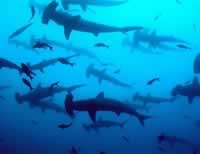
walls that truly excite divers. Schools of hammerhead sharks, grey reef
sharks, leopard sharks, manta rays, hawksbill turtles and the occasional
threshers and silvertip sharks can all be seen. The months of April and May
are the best times to see schools of scalloped hammerhead sharks, which gather
to perform mating rituals. The
corals are plentiful and healthy with sea fans more than three meters across.
The 20m deep lagoon has some great macro creatures to be found including
seahorses, cuttlefish and pipefish but it is the pelagics visiting the outer
walls that truly excite divers. Schools of hammerhead sharks, grey reef
sharks, leopard sharks, manta rays, hawksbill turtles and the occasional
threshers and silvertip sharks can all be seen. The months of April and May
are the best times to see schools of scalloped hammerhead sharks, which gather
to perform mating rituals.
Tour cruise around the island and night dives are also available. The best
time to visit is during the off-monsoon season from February to September.
Spinner and bottlenose dolphins frequently follow the dive boats to each
location and divers are sometimes rewarded with snorkeling and diving with
these amazing creatures.
|
LAYANG LAYANG DIVE
SITE DESCRIPTION
Valley - An easy dive located at the western tip of Pulau Layang
Layang is a gentle slope beginning at about 10 M and slopes to about 20 M.
This site features excellent hard coral growth with small reef fishes
inhabiting the coral garden. You will find countless fish ranging from
tiny Gobies, Blennies and Wrasses to Reef Sharks. Numerous nooks and
crevices provide a hideaway for invertebrates like Crabs, Shrimps and also
fishes such as Red Coral Trout and other Snappers. Also look out to the
sandy patches - you might see the occasional Leopard Shark resting on the
sandy bed.
Sharks Cave - The highlight for this dive site is sharks and a
cave. The wall drops down to a ledge at around 30 meters where Leopard
Sharks can often be see resting, providing motion is slow and limited you
can get quite close to them. The cave itself is a little further along at
a depth of around 25 M and with a 3 M entrance you can penetrate around 6
M. Several white tips, leopard and nurse sharks can be found resting on
the bottom. Be sure not to disturb them as a flurry of divers, bubbles,
sediment and confused sharks in a cave can be extremely unpleasant for all
involved.
D' Wall - This is an interesting wall dive, with the reef top
starting at about 6 M and plunging down rather steeply at an inverted
angle, cutting off the sunlight. Visibility is usually better than most
sites around and is about 40+ M. Coral life on the face of the wall is
quite spartan, probably from the nature of the steep wall. Several black
coral bushes, colourful dendronephthya soft corals, sponges and clusters
of tunicates carpet the wall. The coral garden is populated with small
reef fishes darting about, Red Coral Trout and several big Emperor Angels.
Big Moray Eels make their home in several crevices on the wall, playing
hide and seek with divers, popping in and out of the lair. In the
openwater, schools of Surgeonfish, Fusiliers, Jacks and sometimes Manta
Rays cruise by. Large schools of Pennant Butterfly fish also can be seen
hovering around the coral garden, probably seeking out food. White tip
reef sharks are frequently sighted, and after a while you stop noticing
them. The reef top is quite interesting with abundant marine creatures
foraging for food among the hard coral formations, keeping the diver
occupied during his safety stop.
Snapper Ledge - Snapper ledge is a safe and easy dive with
magnificent corals and colour-full reef fish galore, for the photographer
it is a good wide angle spot, macro and close-up area when the sun is
directly on it. One can simply drift along with the current. Once again
remember your depth and avoid collision with the corals please.

Runway - The runway is an breath taking dive its deep vertical
walls, gullies and creavasses galore to explore. Along the steep vertical
walls on is in awe at the corals that defy gravity as they grow and expand
out into the blue. Reef fish swim in the vertical mode which at first
glance seems to be an-unusual phenomenon. Schools of Jacks cascade down
the wall like water from a waterfall. Schools of Bait Fish, Fusiliers,
Surgeon Fish sparkle and glitter in the crystal clear water. Sharks and
Manta-rays cruise the wall and shy they are not, Hammerhead have on
occasion been seen in this area so always look to sea, fingers crossed of
course. Remember that the depth limits is 40meters in these waters it is
easy to accidentally exceed this limit, especially the photographers
amongst you. With regard to photography one can go loaded with close-up or
wide angle either way one should not be disappointed with the results.
Tunnel - Tunnel spot is a little more sheltered than the rest of
Layang Layang's dive sites. This spot is similar in topography as wreck
point. The only difference is that there are no sand slopes to settle in
so please maintain good buoyancy control. We have a feast of hard corals
such as, Staghorn, Plate, Table, Mushroom and Brain Corals. The occasional
Turtle drifts past with an indifference that only these 'wise old man of
the sea' can exuded. At 10 M the coral slope gives way to a vertical drop
off which is home to soft corals, sponges of all descriptions and colour.
Schools of Amber-jacks swim by as if on parade on occasion they can be
seen swimming around as if mimicking a large barrel. If one drifts to this
formation slowly one can enter the coil of fish and providing you swim in
the same circular manner the 'jacks' accept you as one of their own and
around and around you go with your new found friends of the sea.
Wreck Point - Despite its name this dive site does not actually
have a wreck anymore, there used to be one but only a few scraps remain.
The topography here is a shallow reef with coral gardens ideal for both
diving and snorkelling. Many varieties of hard corals and smaller reef
fish can be found here and this spot is also good for night dives. The
wall seems to drop off to infinity after the 30 M mark, this is where you
may spot the bigger visitors.
Dogtooth Lair - Located just minutes from the resort, Dogtooth Lair
probably got its name from the numerous sightings of these tunas
encountered during dives. The reef topography starts at about 7 M and
slopes down into the depths. Passing schools of barracudas can be seen at
the shallows along with fusiliers and surgeonfish. The wall is typical of
those around Layang Layang, featuring steep walls of corals, interspaced
with small ledges. There is also a popular site to encounter the schooling
hammerheads swimming against the current. Dogtooth Lair can sometimes
experience fierce currents due to its location at the corner of the atoll.
However, currents bring rich nutrients and attract a chain of predators.
Gorgonian Forest - Most dive sites around Layang Layang follow a
similar dive profile with the reef top starting at 5 to 12 M and sloping
steeply down. Gorgonian Forest, as the name suggests, is a virtual forest
of fabulous sea fans swaying with the currents along the slopes from about
14 M down to 40 M. Bushes of black coral and whip coralsshare the seascape
with small marine reef fishes. The stillness of the dive site is
interrupted by the presence of scalloped hammerhead sharks, either
solitary, swimming close to the reef or in a school, cruising off the wall
in the open water usually against the flow of the currents. It is a
magnificent sight to behold, their heads swaying from side to side unlike
any other shark, swimming in formation. An advice to underwater
photographers: These animals are easily spooked, especially if you utilize
a flash. They are best photographed with available light, capturing their
silhouette shapes in the blue water.
Navigator Lane - This is a magnificent dive with abundance of
healthy corals, sea fans, whips and fantastic hard coral formations that
are so dense that you cannot put your hands down without damaging the
corals! This dive is one of colour and breath taking beauty, the corals
alone are simply awesome and the fish life is in abundance and of every
size and description. The Hammer-heads are also seen here on regular basis
and in great numbers. For the photographer you will hit the water loaded
for panoramic views and large pelagic and see a colorful Nudibranch, it is
that kind of place so one dive this site a couple of times to get the full
scope of what magnificent marine life that it holds.
Crack Reef - Crack-reef is another relaxing dive site with a lot of
reef activity and fantastic gravity defying corals, sponges, sea-whips and
sea-fans galore. The fish tumble down the wall side and then race back up
the wall side as if going to the surface for air. Turtles cruise along the
steep walls and gentle glide passed you in an indifferent attitude of one
of those weird looking things again White-tip sharks lazily drift by and
the occasional. Dog-tooth Tuna swims with purpose passed you in display of
defiance and strength. We call it Crack-Reef because the dive begins on a
large vertical crack in the wall that starts at the surface and plummets
to 40+M, please remember your depth limit and air consumption. At times we
have had strong currents that help you cruise the wall with ease so please
do not grad onto the coral formations so you can get that one shot in a
million, OK! Once again the photographers can go loaded and armed with
close-up and or wide angle.
Wrasse Strip - This is a seriously impressive coral dive with coral
gardens absolutely jam packed with every variety of hard and soft coral
competing for the light and warmth above. Coral bommies with their
territorial fish inhabitants are abound, the sheer concentration of corals
and smaller fish is breath taking. Towards the deeper waters eagle rays or
a manta may be spotted.
|
Situated on the other end of the island is a
bird sanctuary. Pulau Layang Layang provides refuge to an abundance of
resident and migratory bird species. This remote island, lying in a vast
expanse of ocean, represents a rare opportunity for birds to rest and breed,
and provides a habitat for resident birds.

Sea birds known to utilise Pulau Layang Layang to breed include Sooty Terns
(Sterna fuscata), Black-naped Terns (Sterna sumatrana), Great Crested Terns
(Sterna bergii), Brown Boobies (Sula leucogaster) and Brown Noddies (Anous
stolidus). In addition to these, many stray migratory species use the island
as a resting place to refuel before continuing on their arduous journey.
The importance of this area as a haven for bird life has been recognised,
leading to Pulau Layang Layang being designated as a Bird Reserve.

Accommodations
For those wishing to stay, visitors can choose between chalets or the
comfortable rooms three-star resort. Every room is air conditioned with
private amenities and comes equipped with TV, fridge, extra size beds and a
private oceanfront balcony. There is a 200 seat restaurant, full service PADI
dive centre, a free form water pool
Getting There
Located about 165 nautical miles northwest of Kota Kinabalu. Accessible with
regular flights from Kota Kinabalu, which is the only mode of transport for
guests visiting Layang Layang. The flight takes about one hour from Kota
Kinabalu
The nearest kickoff point to Pulau Layang Layang is from Kota Kinabalu, Sabah.
Where direct flights are available from Tokyo, Taipei, Kaohsiung, Seoul, Hong
Kong, Manila, Cebu, Singapore and Kuala Lumpur. From Kota Kinabalu a private
charter company flies clients to Layang Layang, arranged by Layang Layang
Island Resort.
|
|