|
� History � The City �
Getting There �
Kuching, the capital (which means
"Cat" in Malay), Kuching is the most populous city in the state of Sarawak
and the fourth largest city in Malaysia. With a population of about half a
million people, it is without doubt the most pleasant and interesting city
in Borneo. It is hilly, leafy and has a very pleasant riverside area.
History
Kuching stated as a riverine mining settlement established initially by
Brunei chiefs to oversee the mining of antimony in the Sarawak river
valley, which was used as an alloy to harden other metal particularly
pewter � which was then exported to Singapore, where the tin plate
industry was developing.

When the James Brooke first sailed in 15 Aug 1839, the settlement, 32 km
upriver was described as �a very small town of brown huts and longhouses
made of wood or the hard stems of the nipah palm, sitting in brown squalor
on the edge of the mudflats. By the time James Brooke became Rajah in
1842, the town had a population of local Malays, Dayaks, and Chinese
traders, with Chinatown dominating the south side of the river while the
Malay kampungs out along the riverbanks to the west. Under Charles Brooke
the second �White Rajah�, as Kuching began to flourish, the towns main
public buildings were built.
The City
Kuching is said to be one of the most liveable and people-friendly city in
the region. It is a green and clean city that has all the modern amenities
without losing its old world charm where multi-storey buildings blend well
with structures from its colonial days. As its river front remain a focal
point of the city , Kuching Waterfront was developed to give the city its
own character.
Sarawak�s Capital is divided by the Sarawak River; the South is a
commercial and residential area, dominated by Chinese, while the North
shore is predominately Malay in character with the old kampung houses
lining the river. The two parts of the city is very different in
character.
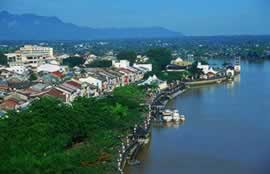 In
Kuching, there are old Chinese temples, Brooke era buildings with unique
architecture, waterfront park, observation towers and museums. The city
contains many beautifully landscaped parks and gardens, historic
buildings, traditional Chinese shop houses, colourful markets, various
Chinese temples, a striking state mosque and has one of Asia�s best
museums. The river, which is a focal point of the city, separates the
northern and southern part of the city which features a graceful, European
style esplanade- the Kuching waterfront, with views across to the Astana
(the Palace), and Fort Margherita. In
Kuching, there are old Chinese temples, Brooke era buildings with unique
architecture, waterfront park, observation towers and museums. The city
contains many beautifully landscaped parks and gardens, historic
buildings, traditional Chinese shop houses, colourful markets, various
Chinese temples, a striking state mosque and has one of Asia�s best
museums. The river, which is a focal point of the city, separates the
northern and southern part of the city which features a graceful, European
style esplanade- the Kuching waterfront, with views across to the Astana
(the Palace), and Fort Margherita.
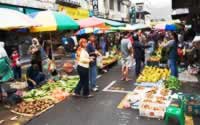 The
colourful Sunday Market is where household items, souvenir items and
exotic jungle produce are sold in various forms. The Market was started in
1980 by the Kuching Municipal Council to allow unlicensed hawkers to sell
numerous consumable items like fish, meat, clothing, flowers and jungle
produces of various kinds. The Sunday Market has become so popular over
the years that one looks forward to it. The
colourful Sunday Market is where household items, souvenir items and
exotic jungle produce are sold in various forms. The Market was started in
1980 by the Kuching Municipal Council to allow unlicensed hawkers to sell
numerous consumable items like fish, meat, clothing, flowers and jungle
produces of various kinds. The Sunday Market has become so popular over
the years that one looks forward to it.
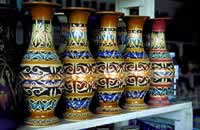 One
of the highlights of Kuching is a visit to one of the few ceramic
factories just outside town. Sarawak is famous for its unusually decorated
earthenware vases of all shapes and sizes. Kuching pottery incorporates
the ancient Dayak designs with a blend of modern colour and technique.
Small vases with traditional designs make good souvenirs and are popular
with tourists who visit many handicraft shops or directly purchase them
from factories. The pottery-making factories have now become a regular
souvenir-hunting place for tourists who depart with Sarawak pottery to
remind them of their delightful stay in Kuching. One
of the highlights of Kuching is a visit to one of the few ceramic
factories just outside town. Sarawak is famous for its unusually decorated
earthenware vases of all shapes and sizes. Kuching pottery incorporates
the ancient Dayak designs with a blend of modern colour and technique.
Small vases with traditional designs make good souvenirs and are popular
with tourists who visit many handicraft shops or directly purchase them
from factories. The pottery-making factories have now become a regular
souvenir-hunting place for tourists who depart with Sarawak pottery to
remind them of their delightful stay in Kuching.
Getting There
The airport 10 km south of Kuching and there are daily flights from Kuala Lumpur as well as regular flights to
other destinations in Borneo and the rest of Malaysia. International
connections are limited to Bandar seri Begawan (Brunei), Singapore, Hong
Kong (via Kota Kinabalu) and Perth.
Other than the sights and places to visit in Kuching, within easy reach is
the Semmengoh Orang Utan Sanctuary and the rainforest parks of Gunung
Gading, Kubah and Tanjung Datu National Park. North of Kuching is the
Damai Peninsula and the Bako National Park
RELATED LINKS
|
|


