|
History
The modern history of Sarawak, whiffs of Victorian melodrama. Known to
Portuguese cartographers as Cerava, Sarawak, had been a loosely governed
territory under the control of the Brunei Sultanate in the early 19th
century.
 In
1838 James Brooke, a British adventure with an inheritance and an armed
sloop arrived to find the Brunei Sultanate fending off rebellion from war
like inland tribes. Sarawak was in chaos, Brooke put down the rebellion
and as a reward signed a treaty in 1841 was bestowed the title Governor
and granted power over parts of Sarawak. He pacified the natives,
suppressed headhunting, eliminated the much-feared Borneo pirates,
bringing ever growing tracts of Borneo under their control. Brooke was
appointed Rajah by the Sultan of Brunei on August 18, 1842 and founded the
White Rajah Dynasty of Sarawak. The Brooke dynasty ruled Sarawak for a
hundred years and became famous as the "White Rajahs", accorded a status
within the British Empire similar to that of the rulers of Indian princely
states. Indeed, in 1850 the USA recognised Sarawak as an independent state
� as did even the British, in 1864! In
1838 James Brooke, a British adventure with an inheritance and an armed
sloop arrived to find the Brunei Sultanate fending off rebellion from war
like inland tribes. Sarawak was in chaos, Brooke put down the rebellion
and as a reward signed a treaty in 1841 was bestowed the title Governor
and granted power over parts of Sarawak. He pacified the natives,
suppressed headhunting, eliminated the much-feared Borneo pirates,
bringing ever growing tracts of Borneo under their control. Brooke was
appointed Rajah by the Sultan of Brunei on August 18, 1842 and founded the
White Rajah Dynasty of Sarawak. The Brooke dynasty ruled Sarawak for a
hundred years and became famous as the "White Rajahs", accorded a status
within the British Empire similar to that of the rulers of Indian princely
states. Indeed, in 1850 the USA recognised Sarawak as an independent state
� as did even the British, in 1864!

This regal butterfly was named in honour of Sir James Brooke, the first
White Rajah of Sarawak Rajah Brooke's Birdwing - by the famous British
naturalist, Alfred Russel Wallace in 1855.
His successor, Charles Brooke, 1868-1917, was responsible for many of the
historic buildings still associated with the waterfront.
Japan invaded Sarawak and occupied the island of Borneo in Dec 1941, and
held it for the duration of World War II until the area was secured by
Australian forces in 1945. The Last White Rajah, Charles Vyner Brooke,
formally ceded sovereignty to the British Crown on July 1, 1946, and
Sarawak became a British colony. It became an autonomous state of the
federation of Malaysia on September 16, 1963. Sarawak was one of the main
sites of the Indonesian Confrontation between 1962 and 1966.
People of Sarawak
Sarawak has more than 40 ethnic groups, each with their own distinct
language, culture and lifestyle. Making up a population of about 2.5
million The majority of the population reside in a few large urban
centres, but a significant percentage still live in longhouses and
villages in the interior. Most of the ethnic groups originally came from
Kalimantan

Cities and larger towns are populated predominantly by Malays, Melanaus,
Chinese, and a smaller percentage of Ibans and Bidayuhs who have migrated
from their home-villages for employment reasons. Sarawak distinct from the
rest of Malaysia, only has a small community of Indians. Sarawak
population is growing at a rate of 4-5% per year and has tighter
immigration controls, even for Malaysians coming in from other states.

Sarawakians practice a variety of religions, including Islam,
Christianity, Chinese folk religion (a fusion of Buddhism, Taoism,
Confucianism and ancestor worship) and animism. Many converts to
Christianity among the Dayak peoples also continue to practice traditional
ceremonies, particularly with dual marriage rites and during the important
harvest and ancestral festivals such as Gawai Dayak, (harvest Festival)
Gawai Kenyalang (Hornbill Festival) and Gawai Antu (Festival of the Dead).
Ibans
The Ibans form the largest percentage of Sarawak's population, making up
some 30%. Once known as the legendary headhunters of Borneo, the Ibans of
today are a hospitable and placid people. The Ibans are originally from
Kalimantan, and so their culture and traditions as observed in Sarawak are
very similar to the Dayaks in Kalimantan.
 Because
of their history as pirates and fishermen, they were conventionally
referred to as the "Sea Dayaks". The Ibans dwell in longhouses, a stilted
structure comprising many rooms housing a whole community of families. Because
of their history as pirates and fishermen, they were conventionally
referred to as the "Sea Dayaks". The Ibans dwell in longhouses, a stilted
structure comprising many rooms housing a whole community of families.
The Ibans are renowned for their Pua Kumbu (traditional Iban weavings),
silver craftings, wooden carvings and beadwork. Iban tattoos which were
originally symbols of bravery for the Iban warriors have become amongst
the most distinctive in the world. The Ibans are also famous for their
tuak, a sweet intoxicating rice wine which is served during big
celebrations and festive occasions.
The majority of Ibans practice Christianity. However, like most other
ethnic groups in Sarawak, they still hold strong to their many traditional
rituals and beliefs.
Chinese
Making up 29% of the population of Sarawak as elsewhere they are amongst
Sarawak's most prosperous ethnic groups. Though predominantly Buddhists
and Christians,tThe Chinese maintain their ethnic heritage and culture and
celebrate all the major cultural festivals, most notably Chinese New Year
and the Hungry Ghost Festival. The Sarawak Chinese are predominantly
Buddhists and Christians.
The Sarawak Chinese belong to a wide range of dialect groups, with Hokkien,
Hakka and Mandarin being the most widely spoken dialects.
The Malays
The ethnic Malay of Sarawak is pretty much similar to its counterpart in
the Peninsula of Malaysia with the exception of some local dialects
commonly associated in Sarawak. The Malays make up about one-fifth or
about 21% of the total population in Sarawak.
Traditionally fishermen, these seafaring people chose to form settlements
on the banks of the many rivers of Sarawak. Today, many Malays have
migrated to the cities where they are heavily involved in the public and
private sectors and taken up various professions. Malay villages
(kampungs) - a cluster of wooden houses on stilts, many of which are still
located by rivers on the outskirts of major towns and cities, play home to
traditional cottage industries. The Malays are famed for their wood
carvings, silver and brass craftings as well as traditional Malays textile
weaving with silver and gold thread (kain songket). Malays are Muslim by
religion
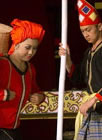 Melanau Melanau
One of the earliest settlers of Sarawak, the Melanaus can be divided into
six different groups each with its own characteristic dialect.
Traditionally, the Melanaus lived in tall houses and were fishermen and
till today, they are reputed as some of the finest boat-builders and
craftsmen. Though ethnically different from the Malays, they have adopted
a Malay lifestyle, living in kampong-type settlements. The Melanaus were
originally animist and worshipped the spirits. Today most of them are
Muslims and some are Christians, though they still celebrate traditional
animist festivals such as the annual Kaul Festival.
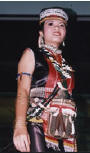 Bidayuh Bidayuh
Bidayuh is the collective name for several indigenous groups found in
southern Sarawak that are broadly similar in language and culture. The
second largest Dayak ethnic group in Sarawak after the Iban, they are most
numerous in the hill country of Bau and Serian, within an hour's drive
from Kuching. Originally from West Kalimantan, the Bidayuhs speak a number
of different but related dialects. Historically, as other tribes were
migrating into Sarawak and forming settlements, the meek-natured Bidayuhs
retreated further inland, hence earning them the name of "Land Dayaks".
While some of them still practice traditional religions, most modern-day
Bidayuhs have adopted the Christian faith. The traditional Bidayuh abode
is the "baruk", a roundhouse that rises about 1.5 metres off the ground.
Typical of the Sarawak indigenous groups, the Bidayuhs are well-known for
their hospitality, and are reputed to be the best makers of tuak, or rice
wine.
Orang Ulu
The phrase Orang Ulu means "remote or upriver people� is an ethnic
designation politically coined to group together roughly 27 very small but
ethnically diverse tribal groups that live upriver in Sarawak's vast
interior. With a population ranging from less than 300 persons to over
25,000 persons, such groups include the major Kayan and Kenyah tribes, and
the smaller neighbouring groups of the Kajang, Kejaman, Punan, Ukit, and
Penan. Nowadays, the definition also includes the down-river tribes of the
Lun Bawang, Lun Dayeh(mean upriver/far upstream), Murut, Berawan, Saban as
well as the plateau-dwelling Kelabits.
The various Orang Ulu groups together make up roughly 5.5% of Sarawak's
population. The Orang Ulu are artistic people with longhouses elaborately
decorated with murals and woodcarvings. They are also well-known for their
intricate beadwork detailed tattoos. The Orang Ulu tribe can also be
identified by their unique music - distinctive sounds from their sape, a
stringed instrument not unlike the mandolin. A vast majority of the Orang
Ulu tribes are Christians but old traditional religions are still
practiced in some areas.
Some of the major tribes making up Sarawak's Orang Ulu group include :
 Kayan Kayan
There are abour 27,000 Kayans in Sarawak and are mainly found in the
northern interiors of Sarawak midway on the Baram River, the upper Rejang
River and the lower Tubau River. Categorized as a part of the Dayak
people, they are known for being fierce warriors, former headhunters,
adept in dry-rice cultivation, and having extensive tattoos and stretched
earlobes amongst both sexes. Their basic culture is similar to the other
Dayak people of Borneo. Traditionally they live in long houses on river
banks. Their agriculture was based upon shifting cultivation techniques
and the cultivation of dryland rice. They also cultivate sago, and go
hunting and fishing. Their society knows aristocrats. They are known for
good carvings and metalwork. Their language belongs to the
Malayo-Polynesian branch of the Austronesian language family and although
many Kayan have become Christians, some still practise the old paganistic
beliefs
Kelabit
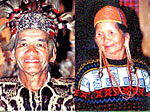
One of the smallest tribes in Sarawak and, now, a branch of the Orang Ulu,
the total Kelabit population of about 6000 people. First "discovered"
around the turn of the 20th Century, the Kelabits, a tribe of fierce
warriors and headhunters who saw off anyone entering their territory, were
generally given a wide berth by neighbouring tribes. Under broad conical
hats, they wore their hair long at the back or done up in a bun held in
place by pins of metal or horn. Around the waist hung a long sword-parang
with a curved staghorn hilt and wooden scabbard. The men had two holes on
each ear, pierced during infancy. The bottom hole was adorned with heavy
brass ear rings which greatly extended the ear lobes so that they often
hung down to the shoulders. In the upper hole, kept open by wooden plugs,
the warriors wore leopard's fangs.
 Their
homeland, now called the Kelabit Highlands, a remote plateau in the
Sarawak Highlands, slightly over 1,200 meters above sea-level, is pretty
ringed by a series of jungle-covered mountain peaks. All roads on the
plateau lead to Bario, a settlement of about 1,000 persons Their
homeland, now called the Kelabit Highlands, a remote plateau in the
Sarawak Highlands, slightly over 1,200 meters above sea-level, is pretty
ringed by a series of jungle-covered mountain peaks. All roads on the
plateau lead to Bario, a settlement of about 1,000 persons
The Kelabits, predominantly Christian are a tight-knit community that live
in inherited longhouses and practice a generations-old form of
agriculture. Famous for their rice-farming, they also cultivate a variety
of other crops which are suited to the cooler climate of the Highlands of
Bario. Domesticated buffalo are valued highly, seven of which are
traditionally required for the dowry for an upper class bride.
Kenyah
The Kenyah tribe, with a population of about 25,000, their culture is very
similar to that of the Kayan tribe with whom they live in close
association. Their heartland however,
is Long San, along the Baram River.
The typical Kenyah village consists of only one longhouse and each long
house is like a family where they have to choose their own leader. Before
they become Christian they believe in 'Bungan Malan Peselong Luan' (
traditional religion was a form animist) which is like their God for
protection and healing. The people are mainly farmers, planting rice in
burnt jungle clearings. With the rapid economic development, especially in
timber industry, many of them work in timber camps.
Penan
The Penan are the only true nomadic people in Sarawak and amongst the last
of the world's hunter-gatherers. The Penan make their home under the
rainforest canopy, deep within the vast expanse of Sarawak's virgin
jungle. Even today, the Penan continue to roam the rainforest hunting wild
boar and deer with blowpipes.
They eat plants, which are also used as medicines, and animals and use the
hides, skin, fur, and other parts for clothing and shelter. Everything
that is caught is shared as the Penan have a highly tolerant, generous and
egalitarian society, so much so that it is said that the nomadic Penan
have no word for 'thank you' because help is assumed and therefore doesn't
require a 'thank you'. The Penan are skilled weavers and make high-quality
rattan baskets and mats. The traditional Penan religion worships a supreme
god called Bungan.

However, an increasing number have abandoned the nomadic lifestyle for
settlement in longhouses and have converted to Christians. Today the Penan
number around 10,000; of which around 350-500 are nomadic They have
settled into small settlements, usually based around a village
'longhouse', typical of other tribes of Sarawak's interior. Some,
typically the younger generations, now cultivate rice and garden
vegetables.
Since both the settled, semi-nomadic and nomadic Penan communities were
and are reliant on forest produce, they were hit hard by the large scale
logging operations that encroached on their traditionally inhabited
territories.
The confrontation between the Penan and Sarawak State Government has
continued to the present day.
The best way to view the culture and traditions of Sarawak's multi ethnic
population is to visit the Sarawak Cultural Village which is located at
the foot of the legendary Mt Santubong, 32 kms from Kuching City
|
|

