|
� Longhouse Communal Living � The Longhouse
� Longhouse Visits � Do and
Don'ts �
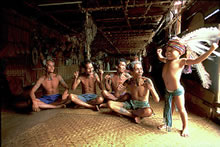 Longhouse
Communal Living Longhouse
Communal Living
Imagine this - take every family in a village and lump them all under the
same roof and while you are at it, eliminate the concept of individual
possessions and divide the goods equally, down to the last cigarette.
Finally, throw in the condition that, under that one long roof, each
family must live, sleep, and eat together in a single room about the size
of a mini-bus. This the is the concept of longhouse communal living -
along the shores of the endless, snaking rivers that carve through the
steamy rain forests of Borneo, tribal peoples have been living this way-
by choice, for thousands of years.
Crime is practically unheard of in these communities, along with divorce,
child-abuse, and most of the other social diseases the rest of the world
resigns itself to every day. Cultural tradition holds that anyone who
visits them is welcome to stay as long as they like. In an environment
where respect for each other's space is essential to a healthy community,
even the family dogs seem to honour each other's small territory. They
doze immediately in front of each household, respecting their invisible
barriers.

At night, just after supper, the main hall livens up. Families come out to
socialize and guests gather in front of the chief's room. The chief's home
is almost always in the dead centre of the building, and is often
distinguished by a fetish of antique human skulls, a reminder of the days
when the Iban and other tribes in Borneo practiced headhunting.
The Longhouse
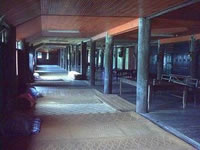
Most longhouses are built on stilts, high on the riverbanks. With their
commanding views of the river, an average longhouse has 20 � 25 doors
(although they can be as many as 60). Each represents one family. The word
long in a settlement name � as Long Liput or Long Terawan means
�confluence� and does not refer to the length of the longhouse. Behind
each door is a bilik or room which includes the family living room
and a loft, where paddy and tools are stored. The living rooms are simple
attap roofed, bamboo floored. In modern longhouses which are designed on
exactly the same principles - The living rooms are commonly furnished with
sofas, lino floors, a television and an en suite bathroom.

At the back of the bilik is the dapur or kitchen, where the
cooking takes place. All biliks face out unto the ruai
(gallery), which is where visitors are usually entertained. The width of
the wall which faces onto the ruai indicates the status of the
family. Attached to the ruai is usually the tanju (open
verandas), running the full length of the house � where rice and other
agricultural products are dried. Lang ladders (notched hardwood trunks) �
lead up to the tanju, there can get very slippery and do not always
come with handrails.
Longhouse Visits
There are more than 1,500 longhouses in Sarawak and are usually situated
along the big rivers and their tributaries. Notably the Skrang, the Rejang
and the Baram.
 The
Iban who are characteristically extrovert and hospitable to visitors live
on the lower reaches of the rivers. The Orang Ulu trbes � mainly Kayan and
Kenyah, live further upriver and are generally less outgoing than the Iban.
The Bidayuh are mainly around Bau and Serian, near Kuching. Their
longhouses are usually more modern. The
Iban who are characteristically extrovert and hospitable to visitors live
on the lower reaches of the rivers. The Orang Ulu trbes � mainly Kayan and
Kenyah, live further upriver and are generally less outgoing than the Iban.
The Bidayuh are mainly around Bau and Serian, near Kuching. Their
longhouses are usually more modern.
The most accessible longhouses belong to Sarawak's Iban tribe (also called
the Sea Dyaks) and are situated off the Skrang, Lemanak, Batang Ai and
Rejang River areas. Because of Borneo's impenetrable rain-forest, getting
to them almost inevitably involves a river ride in a long, pencil-thin
boat called a perahu, the workhorse of the Sarawakian waterways.
 The
mot important ground rule is not to visit a longhouse without an
invitation. People who arrive unannounced may get an embarrassingly frosty
reception. Tour companies offer the only exception to this rule, as most
have tribal connections. The best time to visit the longhouse is during
the Gawai harvest festival at the beginning of June, where communities
throw an open house and everyone is invited to join in the festivities. The
mot important ground rule is not to visit a longhouse without an
invitation. People who arrive unannounced may get an embarrassingly frosty
reception. Tour companies offer the only exception to this rule, as most
have tribal connections. The best time to visit the longhouse is during
the Gawai harvest festival at the beginning of June, where communities
throw an open house and everyone is invited to join in the festivities.
 On
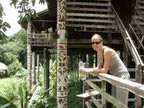
arrival visitors should pay an immediate courtesy call on the headman (the
tuai rumah in Iban Longhouse). It is normal to bring him gifts, those
staying overnight should offer the headman between RM 10 � RM 20 per head.
The money is kept in a central fund and saved for use by the whole
community during festivals. Small gifts such as beer, coffee, biscuits,
whisky, batik and food (especially rice and chicken) go down well. It is
best to arrive at the longhouse late afternoon after people have returned
from the fields. Visitors who have time to stay for the night generally
have much more enjoyable experience than those who pay fleeting visits.
They can share the evening meal and have time to talk and drink. On
arrival visitors should pay an immediate courtesy call on the headman (the
tuai rumah in Iban Longhouse). It is normal to bring him gifts, those
staying overnight should offer the headman between RM 10 � RM 20 per head.
The money is kept in a central fund and saved for use by the whole
community during festivals. Small gifts such as beer, coffee, biscuits,
whisky, batik and food (especially rice and chicken) go down well. It is
best to arrive at the longhouse late afternoon after people have returned
from the fields. Visitors who have time to stay for the night generally
have much more enjoyable experience than those who pay fleeting visits.
They can share the evening meal and have time to talk and drink.
Do's and Don'ts
� On entering the longhouse � take off your shoes.
� Accept food and drink with both hands. If you do not want to eat or
drink, the accepted custom is to touch the brim of the glass or the plate
and then touch your lips as a symbolic gesture. Sit cross legged when
sitting.
� When washing in the river, women should wear a sarong and men, shorts.
� Ask permission to take photographs. It is not unusual to be asked for a
small fee
� Do not enter the longhouse during pantang (taboo) � a period of
misfortune (normally following a death). There is normally a white
(leaf)
flag hanging near the longhouse to indicate this. During this period
normally one week, there is no singing, dancing or music and no jewellery
is worn.
� Bow your head when walking past people older than you
|
|

