|
� The Astana �
Fort Margherita � The Court House � Round Fort � Square Tower � War Memorial �
The Astana
The Astana which lies in regal splendor across the river, is a majestic
building with romantic history. The second Rajah, Charles Brooke, built
this palace in 1870 as a bridal gift for his wife, the Ranee Margaret.
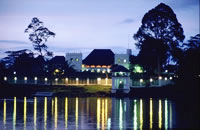 First
occupied by Charles Brooke in 1870, it was the private residence of the
second Rajah. Then known as the Government House, it is actually three
separate buildings fused into one, with each connected to the other by
short and narrow passageways. First
occupied by Charles Brooke in 1870, it was the private residence of the
second Rajah. Then known as the Government House, it is actually three
separate buildings fused into one, with each connected to the other by
short and narrow passageways.
It has undergone substantial alterations and renovations and is today the
official residence of the Yang di-Pertua Negeri, the Governor of Sarawak.
As it is an official residence, the Astana is not open to the public.
Visitors however are allowed the pleasure of strolling around the Astana's
beautifully landscaped gardens, which are decorated with ethnic artefacts
 Fort
Margherita Fort
Margherita
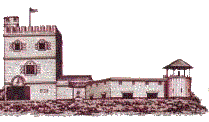
Completed in 1879, Fort Margherita commands a breathtaking and strategic
position along the Sarawak River, with a location chosen to overlook the
long stretch of river approaching Kuching. Named after the second Rajah,
Charles Brooke's wife, the Ranee Margaret, it was built in the defensive
edifice/castle style of the late English renaissance.

Many of its old cannons, cannon balls, guns, pistols, swords and other
vestiges of its artillery can still be seen. The armory still exists as
does the condemned prisoner's cell. The Fort now houses the Police Museum
which has a display of old police weapons, reconstructed opium dens and
scenes of hanging and other forms of criminal punishment.
The three storey tower block's battlement includes watchpoint on top, a
courtyard surrounded by a high wall with sharp glass shards inlaid for
protection and set into the wall itself are wooden windows from where the
cannons were fired. Executions of prisoners were carried out in this
court-yard, right up to the Japanese occupation
The Court House
Built in 1871, the Court House used to be the seat of government during
the days of the 'White Rajahs', and later as the seat of Sarawak's
government. Charles Brooke's daily routine was like clockwork. He would
arise from bed to the boom of the cannon at 5.00am . Having dressed and
breakfasted, he'd stroll down the Astana grounds and hop into his royal
boat for a short trip across to the courthouse to start his workday.
This is an impressive building with belian (ironwood) roof and is
decorated with beautiful engravings reflecting local art form is perhaps
one of the most magnificent buildings in Sarawak. It has a simple form and
plain colonial type appearance with massive tapering brick pillars
supporting the wide veranda.

The Brooke Memorial is just in front the Court House. The 6 meter high
granite obelisk was commissioned in 1924 to honor the second governor,
Rajah Charles Brooke. At the corner of the obelisk is a bronze panel of
four figures representing the main races Chinese, Dayak, Kayan and Malay
of Sarawak. Behind the memorial was the colonial baroque Clock Tower added
in 1883.
Today, the High Court, the Magistrate's Court and several government
departments which was housed in this square, has been relocated to
Petrajaya. The Courthouse's new lease of life has been turned into a
retail and information centre.
Location - Junction of Main Bazaar
and Jalan Tun Abang Haji Openg, facing the Waterfront
Round Fort
Constructed in 1886, the reason for the building of the Round Tower still
unknown. Because of its structure, it is claimed that the building was
meant to serve as a fort in an emergency. Instead it was used as a
Dispensary and later used by the Labor Department until 1980. In earlier
days, the Round Tower was strategically located to provide an excellent
view of the town
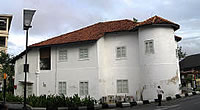 Nowadays
the headquarters of the Sarawak Craft Council, it showcases craftsmen
working on various crafts such as beading work, woodwork, weaving etc.
this strange looking, fortified tower looks a little out of place; wedged
between the old court house and the Pavilion which is distinctively
colonial. Nowadays
the headquarters of the Sarawak Craft Council, it showcases craftsmen
working on various crafts such as beading work, woodwork, weaving etc.
this strange looking, fortified tower looks a little out of place; wedged
between the old court house and the Pavilion which is distinctively
colonial.
 Square
Tower Square
Tower
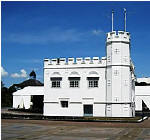
Bulit in 1879, the Square Tower stands majestically with its imposing
neo-classical style and impressive Corinthian columns. In contrast to its
ornate facade with semi-circular arches, ornamental columns capitals and
friezes, the back of the building is plain and unadorned. Deep parapet
walls of plain design hide the pitched roof. A colonnaded portico serves
as a corridor in front of the building. This will soon be converted into
the Sarawak Art Museum.

War Memorial
Located near the Museum, the monument is dedicated to the past warriors of
Sarawak such as Datu' Patinggi Ali and Rentap. This is what written on the
memorial: "In memory of the members of the Sarawak constabulary and the
Malaysian, British and Commonwealth armed forces and civilians who lost
their lives in the defence of right and liberty 1948-1966." May they rest
in peace.
|
|
