|
� The Pavilion and The
Textile and Costume Museum � Sarawak Museum �
� Cat Museum � The Chinese Museum �
The Pavilion and The Textile and Costume Museum
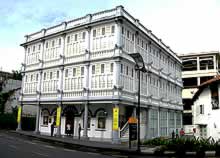
This museum is housed in the Pavilion, three storey rectangular building
that was built in 1907. Used as a hospital and as the Education Department
Headquarters, the architectural enigma of its design is reminiscent of the
buildings in the southern states of America - a mixture of late English
renaissance and colonial architecture.
 The
museum house and display the authentic local textile and costume made by
the ethnic community in Sarawak. The display starts from the weaving
stages and ends up with the complete finishing product. The Pua Kumbu
Museum, on the 4th Floor, displays a superb collection of kumbu textiles,
both antique and modern, as well as exquisite Iban silverware and
jewellery. You can also watch the weavers at work, or even learn the craft
yourself The
museum house and display the authentic local textile and costume made by
the ethnic community in Sarawak. The display starts from the weaving
stages and ends up with the complete finishing product. The Pua Kumbu
Museum, on the 4th Floor, displays a superb collection of kumbu textiles,
both antique and modern, as well as exquisite Iban silverware and
jewellery. You can also watch the weavers at work, or even learn the craft
yourself
Location - Opposite the General Post
Office
Sarawak Museum
This is one of the best museum in Asia and it should not be missed.
Originally built in 1891 to house and display arts and crafts of the
indigenous people of Borneo, the Sarawak Museum has gained a reputation
for having the single most comprehensive collection of Borneo artifacts to
be found anywhere.
 It
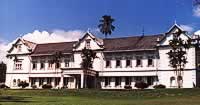
consists of two sections, old and new, connected by a footbridge. The old
wing, the original 1891 building was designed in style of a Normandy
town-house and was extended to its present structure in 1911. The ground
floor of the museum holds the natural history collection and specimens of
Sarawak fauna � reptiles, mammals, birds, etc, The first floor displays
exhibits of ethnographic artifacts such as models of longhouses of the
various ethnic groups in Sarawak, musical instruments, various kinds of
fish
and animal traps, handicrafts, models of boats and others. It
consists of two sections, old and new, connected by a footbridge. The old
wing, the original 1891 building was designed in style of a Normandy
town-house and was extended to its present structure in 1911. The ground
floor of the museum holds the natural history collection and specimens of
Sarawak fauna � reptiles, mammals, birds, etc, The first floor displays
exhibits of ethnographic artifacts such as models of longhouses of the
various ethnic groups in Sarawak, musical instruments, various kinds of
fish
and animal traps, handicrafts, models of boats and others.
The new wing just across the road, was built in the 1970s and has mostly
items such as the colorful jars, brasswares, Chinese furniture, longhouse
gallery and others. Substantial amount of archaeological materials
excavated in Sarawak is also being displayed on this floor as well as a
reconstruction of life in the prehistoric Niah Caves.
Location: Jalan Tun Abang Haji Openg
 Cat
Museum Cat
Museum
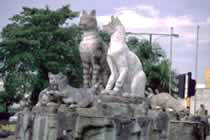
Kuching meaning "Cat" in Malay, has a somewhat of an obsession with cats.
The Cat Museum, the only one of its kind in the world, is located on the
top of a hill called "Bukit Siol" inside Kuching North Council Hall (DBKU).
which stands 60 metres above sea level with a beautiful view of the city
of Kuching.
This museum will delight cat lovers as it displays all kinds of feline
memorabilia, along with displays detailing the evolution and natural
history of the cat family, and the development of the different breeds of
domestic cat. There are 2000 exhibits, artifacts, statues about cats from
all over the world and several small galleries feature among others the
benefits the cats have bestowed on their owners.

The Cat Museum certainly caters to all ages and tastes. Examples of feline
art were everywhere � posters, paintings, album covers, sculptures,
porcelain figurines, etchings, bas-reliefs � you name the medium and
somebody has used it to portray cats. As well as the exhibits in the
museum, there is also a small shop where you can buy all manner of cat
souvenirs
Location: At the Kuching North City
Council
The Chinese Museum
Once housed was the former Chinese court. Recently added are a restored
Chinese pavilion, an observation tower, a tea terrace, a water fountain
and several sculptures.
 The
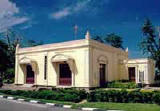
3rd Rajah, Charles Brooke constructed the museum building in 1912 and
became the court for the Chinese population of Kuching. The museum
documents the history of the Chinese in Sarawak, from the early traders of
the 10th Century to the waves of Chinese immigration in the 19th Century.
In 1930 it became the Chinese Chamber of Commerce. The
3rd Rajah, Charles Brooke constructed the museum building in 1912 and
became the court for the Chinese population of Kuching. The museum
documents the history of the Chinese in Sarawak, from the early traders of
the 10th Century to the waves of Chinese immigration in the 19th Century.
In 1930 it became the Chinese Chamber of Commerce.
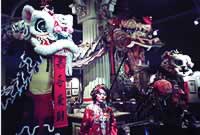 The
museum aims at portraying the rich and fascinating history of Sarawak�s
diverse Chinese groups. Most significantly it endeavors to educate the
present generation to appreciate the struggles and values as encountered
and instilled by the early pioneers. Visitors will acquire in-depth
historical knowledge relating to the origin of each Chinese dialect group,
their respective traditional skills and cultural heritage, and progress
achieved throughout the years. The
museum aims at portraying the rich and fascinating history of Sarawak�s
diverse Chinese groups. Most significantly it endeavors to educate the
present generation to appreciate the struggles and values as encountered
and instilled by the early pioneers. Visitors will acquire in-depth
historical knowledge relating to the origin of each Chinese dialect group,
their respective traditional skills and cultural heritage, and progress
achieved throughout the years.
|
|
