|
RAUB
� Bukit Telaga Waterfalls � Jeram Besu Rapids � Lata Jeram (Jeram
Waterfalls) �
� Lata Lembik Waterfalls (Lembik Waterfalls) �
PEKAN
� The Royal Palace � State Museum � Pulau Keladi
Cultural Village � The Tun Razak Memorial Hall �
Raub
Raub is situated 110km from K. Lumpur and 265km from Kuantan
The town is one of the older towns in Pahang was once a gold mining
settlement. The old folk�s tale recounts that in the early 19th
century, an old man and his two sons discovered gold every time they
scooped up the earth in Raub, Thus Raub derived its name from the
Malay word which means �scoop�. Being a gold mining town in the late
1800�s.
 
Raub is said to be built on a labyrinth of tunnels. It�s colonial past
is still evident in the fine old buildings scattered around the town.
Cameron Highlands is located in the Raub district and is only an hour
away from the town. A lot of orchards are to be found here especially
durian orchards in Sungai Kau. Raub is also the main supplier of
bananas to the nation.
 Jeram
Besu Rapids Jeram
Besu Rapids
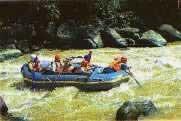
Jeram Besu or Besu Rapids is fast gaining popularity as one of the
best white water-rafting and kayaking spot in the country. The rapids,
(river grade 2 to 4 depending on the river water level) has now
attracted a lot of white water enthusiasts i.e. rafters, kayakers and
canoeists from all over the country even as far as Singapore.
Complemented by its easy accessibility, it is both challenging and
thrilling.
Other activities such as jungle trekking, flying fox, war games and
rubber rafting are also available. Accommodations comes in the form of
chalets, camping sites and hostels.
Located on Sungai Lipis at
approximately 6 km before the town of Benta and about 2 1/2 hours
drive from
 Lata
Jeram (Jeram Waterfalls) Lata
Jeram (Jeram Waterfalls)
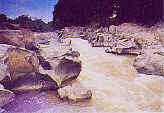
A popular picnic spot next to a series of rapids which culminate in a
clear picturesque rock pool surrounded by tropical greenery. It has
public amenities such as changing rooms and parking lots.
Location: 30km from Raub.
Pekan
Located on the banks of the Pahang River 50
km south of Kuantan, Pekan is the royal town of the state, In fact
when the British first came to Pahang with the appointment of John
Pickersgill Rodger as the first British Resident in October 1888, the
State�s administrative center was located at Pekan. But three years
later, in 1891, the British colonizers moved the state�s
administrative center from Pekan to Kuala Lipis.
From its rich political, social and cultural history, being situated
at the mouth of the Pahang River, the royal town of Pekan has, in the
areas in its vicinity, today blossomed into a very important
industrial center, especially with the location and site of heavy
industrial factories assembling motor vehicles there. The vehicles
assembled range from the assembly of the locally manufactured Proton
cars to foreign marques such as Mercedes Benz. Trucks, lorries, buses
and even armored army vehicles are built there. Truly, Pekan is a
growing "Detroit" of Malaysia.
The main town itself is relatively small, with a wet market, shops,
banks, government offices, and utility companies
 The Royal Palace The Royal Palace
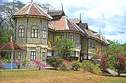
The ruler of Pahang, His Royal Highness the Sultan, resides at the
magnificent palace in Pekan. A stopover to view this authentically
fascinating Malay Palace is worth your trip to Pahang. If you happen
to be there during the celebrations of the Ruler's official birthday
on 24th of October, you would be able to witness the annual outburst
of culture and tradition of this special town.
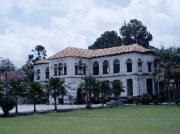 State Museum State Museum
The Sultan Abu Bakar Museum, which is the official name of the Pekan
State Museum, is a good place to unravel the bygone days of Pahang.
The Museum holds more than 10,000 archaeological, historical,
ethnographic and natural history specimens and artifacts. Among the
items displayed are priceless antiques including glassware and
ceramics, as well as exhibits tracing the lineage of the state�s
royalty.
The present brick and stone museum building was originally constructed
in 1929 as the house for the then British Resident. The building
replaced the original wooden bungalow constructed in 1888. During the
Japanese war years of 1942-1945 it served as the headquarters for the
Japanese Army in Pahang.
Location: Jalan Sultan Ahmad,
Pekan
Pulau Keladi Cultural Village
Only 15 minutes away from Pekan is the Pulau Keladi Cultural Village. The cultural village primarily consists of the 'kampung' house where
Tun Abdul Razak was born, the Tun Abdul Razak Memorial Hall, the
Penghulu's (village chief) office and the Pahang Silk Weaving Centre.
The houses are exact replicas of traditional Malay village houses,
including one special one that is meant to house the village chief.
Facilities available in the cultural village include a recreational
area by the river, a service counter, an exhibition and display
centre, handicraft and souvenir stalls, Malaysian style food and
refreshments,
public restrooms and car park.
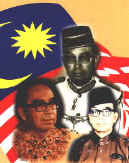 The Tun Razak Memorial Hall The Tun Razak Memorial Hall
Dedicated to the second Prime Minister of Malaysia, this memorial hall
houses some of the late Tun Abdul Razak's personal effects and
memorabilia. Completed in 1994 the showcase depict aspects of the life
of Tun Abdul Razak, an historic figure in the early days of the
nation's development. The house where Tun Abdul Razak was born has
been rebuilt on its original site and in the exact style of the day.
The house displays the characteristic 3 section construction,
comprising a threshold, the 'ibu rumah' (the house proper) and the
kitchen.
Measuring 8.5 metres by 14.15 metres, it offers the visitor a
life like experience of the atmosphere of a typical Malay village
house at the turn of the century.
|
|