|
�
The Sungai Lembing Museum � Lao Zi Temple �
This sleepy
little town is a place of peace and tranquility, especially if one can
take a little time to enjoy the surrounding countryside. The sandy flats
are ideal for fishing or bird watching.
This serene town tucked away about 42 km northwest of Kuantan, and is
almost deserted nowadays. During its heyday, with 700m shaft and 322km
maze of tunnels and employing some 15,000 people was once
thriving mining community. Today, its people has dwindled to a couple of thousand, many of whom
commute to Kuantan to work.
Sungai Lembing had the largest, longest and deepest subterranean tin
mine and was once the richest town and producer of tin in Pahang. The
Japanese when they invaded Malaya in the WW2 tried to work these mines
but without the proper know-how of the Europeans they failed.
 And
when the Europeans returned after war they worked these mines again. But
as time went on, the mines became uneconomical and were closed. And
when the Europeans returned after war they worked these mines again. But
as time went on, the mines became uneconomical and were closed.
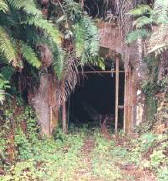
Now abandoned and neglected, nature has worn away many of the mines
shaft tunnels and the supporting wooden beams. If you wish to enter the
tunnels, a guided tour is recommended as some parts are dangerous. Do
engage the services of ex-miners or ex-workers who conduct guided tours.
- A safety helmet, a pair of safety shoes and miners� grade torch lights
are a must.
 The
Sungai Lembing Museum The
Sungai Lembing Museum
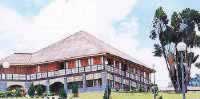
The Sungai Lembing Museum, a refurbished former general managers
bungalow has been reconstructed to give the appearance and atmosphere of
a working tin mine. In this Museum you can find various exhibits and
artifacts from the town�s glorious tin-rich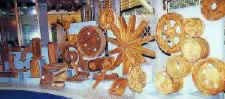 days, including mining
equipment, mineworkers� costumes, furniture and tableware. Not far up
the valley past the museum is the mill, where huge were iron balls were
lifted around revolving steel cages and used to crush the ore into
powder for refining. This process is clearly shown in the museum. days, including mining
equipment, mineworkers� costumes, furniture and tableware. Not far up
the valley past the museum is the mill, where huge were iron balls were
lifted around revolving steel cages and used to crush the ore into
powder for refining. This process is clearly shown in the museum.
The Museum is open daily from 9am
till 5pm
The old expatriate club, close to the museum serves simple but excellent
meals and strong hot village coffee. Past the club on the way to the
mill is a small family run biscuit factory. The crisp, wafery coconut
biscuits are quite famous throughout the eastern part of peninsula
Malaysia.
Visitors to Sungai Lembing today will still be able to see some of the
town�s old characteristics, such as houses and shophouses still spotting
a blend of the Pahang Malay traditional architecture with a Western
influence. Houses occupied by tin miners in the old days are still
standing, including 40 bungalows meant for British officers
If you wish to enjoy a beautiful sunrise as well as a healthy morning
exercise, you can do by starting your climb up Panorama Hill by 6am. It
takes about an hour to reach the summit. Be properly attired for the
climb and bring along sufficient water. A torch light is a must and if
you can get a miner�s headlamp (that straps around your head), it is a
bonus. Bring along a camera and a fresh set of clothes for changing
after the climb.
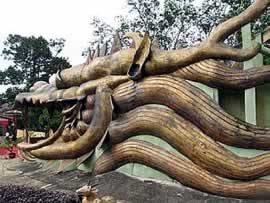 Lao Zi Temple Lao Zi Temple
On the way to Sungai
Lembing, at the 12 km milestone, located within a 6ha plot of private
land is he famed Lao Zi temple. With close to 100,000 visitors a year
coming to pay homage to the founder of Taoism, the main attraction here
is a sculpture of the Golden Dragon, reputed to be the longest in the
world.
Taking about 15 minutes to walk the 823m path, visitors are taken on a
guided tour inside the dragon, going in through its tail and coming out
from its mouth. Written on the walls are a 5,000- word scripture, known
as the �Book of Tao and its Virtues.�

Among the other attractions are the sculpture of Lao Zi measuring 7m
high, a fish pond surrounded by 12 animals from the Chinese zodiac,
brass image of the Goddess of Mercy dating back to the Ming dynasty, a
wishing bell, a pair of longevity and prosperity tortoises, a pair of
�Earth� dragons, images of the 18 Lo Hans (arhats) and the prosperity
Buddha.
There is also a beautiful landscaped garden with fruit trees, rocks
inscribed with words of wisdom and an Antique House containing antiques
of Chinese origin. Most of the antiques are of Chinese origin comprising porcelain wares,
ancient stone carving, brassware and other rare artefacts.
The origin of Taoism and Confucianism could
be traced back to the Zhou dynasty (1122 to 221 BC). Lao Zi was then the
head of the state library and much of his time was devoted to learning
through self-effacement and without fame. After witnessing the decline
of the Zhou dynasty, Lao Zi departed on an oxen to travel westward. In
response to a request from Yinxi � a guardian of the Western Pass � Lao
Zi wrote a book in two sections dealing with Tao religion. In later
times, the book became the most important scripture of Taoism and hence,
Lao Zi was widely regarded as the founder.
It is a common belief here that when one comes out from the Dragon�s
mouth, one will be blessed with the mystical prowess of the dragon, and
will therefore obtain good luck and fortune.
Visitors would often be asked to make a wish and touch the dragon�s
pearl, strategically perched in front of its majestic head.
RELATED LINK
Pahang ~ Gunung Tapis & Gua
Cheras
Other attractions on the way to Sungei Lembing is
the beautiful nature park of Gunung Tapis and the reclining Buddha at
Gua Charas (Charas Cave)
|
|