|

The
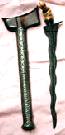
kris or keris, with its elaborately carved handle and wavy blade is a
unique icon in Malay cultural history. In the last century, it
evolved from a royal weapon of choice to a status symbol in Malay
history. The degree of elaborate designs dictated the status in
old Malay hierarchy.
 Historically,
there are several different styles of keris. The largest were used
by the royal guards and warriors. Cradled in the left arm, they
were more like swords, many with straight practical blades, light
in both weight and design. The more common types back then were
heavily ornamented with bulbous handles. Another type is the short
ornamental keris designed for female royalty. This then has become
the definition of the keris � from a practical weapon to a piece
of ornamental jewelry. Historically,
there are several different styles of keris. The largest were used
by the royal guards and warriors. Cradled in the left arm, they
were more like swords, many with straight practical blades, light
in both weight and design. The more common types back then were
heavily ornamented with bulbous handles. Another type is the short
ornamental keris designed for female royalty. This then has become
the definition of the keris � from a practical weapon to a piece
of ornamental jewelry.

The
Keris is more than a weapon
Keris
made in the Malay peninsula often carry a birdlike hilt called the
java demam, while those from Java are smooth elongated
affairs, with small carvings called patra. The warangan
obtained through the complex process or damascene pattern, which
looks like silvery whirls and spirals on the black surface of the
keris. In pre-islamic days, keris hilts were carved in the
humanlike form of Hindu deities.
With
the advent of Islam and its ban on the portrayal of human forms,
it encouraged hilt carvers to incorporate abstract forms and
motifs such as the jawa-demam.
Even
today, many Malay families pass down the odd keris or badik,
a dagger originating from Makasar, as a family heirlooms, with
bits of family lore attached to the weapon. A connoisseur can
trace a family's origins by studying the weapons fittings and
details, which differs in every region of the archipelago. In the
past, people acquired a new keris every time an important event
took place, such as puberty, marriage and the acquisition of
property. When a person reaches puberty, the father would approach
an empu (master smith) to commission the first keris,
giving details of the child's age and characteristics. The gift of
the keris is not to encourage him to fight but to instill a sense
of responsibility.

Keris cleansing
ritual - A kris blade is bathed in a small
wooden trough and dried over hot coals placed in a small incense
burner.
Europeans
had branded the keris as a cowardly weapon, as the blade was said
to be laced with warangan or arsenic, a substance used in
its cleaning ritual. Arsenic attacks the stomach and the
intestines, so the victim dies a slow death as he practically
explodes from within.
The
gradual loss of knowledge about the keris was caused partly by the
long period of colonisation in the region, and the belief that
traditions connected to the weapon were somehow un-Islamic.
A
dying breed of skilled keris craftsmen and blacksmiths undertakes
the making of the keris. The skill being passed down from
generation to generation is now in danger of being lost. The
younger generation lacks the interest and prefers to migrate to
the city in their search for other job opportunities and other
things.

information - details -
regarding
|