|
Don't
miss the local delicacies when you visit Malaysia, you would
really be losing out. Just look, with our multi-cultural social
mix, you certainly can expect somewhat of a unique and endless
blend of cuisine.
 Primarily
consisting of Malay, Chinese and Indian food, it also has its
hybrids derived from cross cultural influences such as Mamak
(Indian-Muslim) and Nyonya (the Malay-Chinese mix).
A
dish with the same name also exists in different location but that
doesn�t mean it�s the same as its of a different flavour and the
'Chinese Rojak� is quite different from the 'Indian Rojak�.
Nevertheless the main staple of diet shared by all Malaysians is
rice, which is steamed and eaten with a variety of dishes. Primarily
consisting of Malay, Chinese and Indian food, it also has its
hybrids derived from cross cultural influences such as Mamak
(Indian-Muslim) and Nyonya (the Malay-Chinese mix).
A
dish with the same name also exists in different location but that
doesn�t mean it�s the same as its of a different flavour and the
'Chinese Rojak� is quite different from the 'Indian Rojak�.
Nevertheless the main staple of diet shared by all Malaysians is
rice, which is steamed and eaten with a variety of dishes.

Hawker
stalls are a favourite haunt for Malaysians from all walks of life.
All over Malaysia you can find them along the roadside or hawker
centres in the marketplace and even in the food courts within shopping malls, Roadside
stall are usually open until midnight and is a great place for a
meet and a chat. There are also the usual complement of coffee
shops, restaurants in different settings and also in the five star
hotels.
Malay
Cuisine
The
dishes have their distinctive spicy flavour, Chilli, lemon grass,
Pandan (screwpine) leaves, daun kesum (polygonum or
laksa leaf),
kunyit (tumerc), bunga kantan (wild ginger buds)
are some of the spices used.

Nasi
Lemak ~ Popularly eaten for breakfast among the locals,
this dish consists
of rice cooked with coconut milk served with sambal ikan
billis (fried anchovies in hot chilli paste), slices of boiled
egg and cucumber, larger portions can include curry chicken,
beef or squid

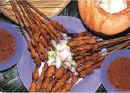
Satay
~ Marinated beef or chicken pieces in skewers are barbecued over
charcoal and eaten after dipping into a sweet and spicy peanut
sauce. It can also be served with ketupat (rice cubes wrapped in
palm leaves) and cucumber.
Nasi
Dagang
~ This glutinous rice dish steamed with coconut milk comes
with dishes of tuna fish curry and a vegetable pickle.
Laksa
Johor
~ Rice noodles in fish curry soup.
Roti
Jala
~ these �lacy pancakes� are made from flour, eggs, a pinch
of tumeric and a bit of butter served with any curry based dish.
Rendang
~ A meat dish cooked
with coconut milk,
chillies, onions, cinnamon,
cloves, coriander and nutmeg. Eaten with ketupat or lemang
(glutinous rice cubes in coconut milk.
Desserts:
Ice Kacang
~ A
colourful concoction of jelly cubes, red beans, creamed corn and
peanuts topped with shaved ice, rose syrup and evaporated milk.
Others ~ Seri Kaya, Ondeh ondeh, Goreng Pisang.
Chinese
Cuisine
The
variety of local Chinese food stems from the different parts of
China from which the early immigrants originated.
There a re a number of restaurants in most major cities that
serves a delectable choice of cuisine such as in the eight or nine
course meal that features exotic dishes of Shark�s Fin Soup�,
Monk Jumps over the Wall� and Peking Duck�. Outlined below are
some of the one - person dishes that can be obtained.
Hainanese
Chicken Rice
~ Rice cooked in chicken stock and topped with steamed
or roasted chicken.
Wantan Mee
~
Soup noodles with prawn or pork dumplings and thin slices of roast
pork or minced chicken.
Assam Laksa
~ A
special from
Penang consisting of thick rice noodles in a spicy and
sour fish-based soup with pineapple, cucumber and onions.
A sweet,
thick prawn paste may be added for extra flavour.
Char Kuey Teow
~
Stir fried flat rice noodles with prawns, cockles, egg and bean
sprouts
Dim Sum
~
Delicate morsels of specialties with over 30 varieties served in
round bamboo baskets. Includes steamed prawn dumplings,
Char Siew
Pau
(steamed bun with sweet roast pork filling) chicken feet
in
collagen,
radish cake and egg custard tart.
Desserts
Mooncakes
~
Available during
the Mooncake Festival� in September, with bean
paste, lotus paste or lotus seed fillings, each with egg yolk if
desired.
Others ~ Almond
Jelly with Fruits, Shanghai Pancakes with Red Bean Paste.
Indian
Cuisine

Local
Indian cuisine can be divided into Northern Indian, Southern Indian and Indian-Muslim (or
Mamak) Cuisine. Northern Indian dishes are
mostly meat based and cooked with yogurt and ghee. Southern Indian
cooking contains a liberal dose of coconut, tamarind and curry
leaves while Indian-Muslim cuisine features rice and vegetables with
rich, thick curries.
Northern
Indian
 Roti
Canai
~ A local
favourite, this pancake is made out of wheat flour dough which
is stretched, layered and fried on a griddle. Variations
include Roti Telur� where egg is added, while Roti Sardin�
is filled with sardines. Delicious when eaten with Dhall�
and meat curries or even plain with sugar. Roti
Canai
~ A local
favourite, this pancake is made out of wheat flour dough which
is stretched, layered and fried on a griddle. Variations
include Roti Telur� where egg is added, while Roti Sardin�
is filled with sardines. Delicious when eaten with Dhall�
and meat curries or even plain with sugar.

Naan
~ A
healthier option, this fluffy and thick bread is baked on the
tandoori, a traditional clay oven and eaten with
Tandoori
Chicken. Other versions include Butter Naan�, Onion
Naan� and Garlic Naan. Capati
~ Flattened bread made from whole-wheat flour and enjoyed with
any curry or served with Potato Masala�, a chunk of mashed potatoes
with vegetables.
Southern
Indian
Thosai
~ Fried pancake with a slightly sourish taste, eaten with
curry. An interesting
modification is the 'Paper Thosai�, a paper thin thosai
served folded into a cone shaped hat which is a lot of fun to eat.
Banana Leaf Rice
~ Rice served on a banana leaf, the first disposable eco friendly
plate, accompanied by a choice of dishes such as dried fish,
papadams (lentil wafers) and chutney. Resam�, a spicy
sourish soup is an accompaniment.
Indian Muslim
Nasi
Kandar
~ Penangs most famous specialty is Nasi
Kandar. Rice eaten
with an assortment of dishes, which include curried squid, chicken, and fish.
Drinks
Lassi
~ Yoghurt
drink that can be ordered plain, sweet or fruit
flavoured.
Teh Tarik
~ A
frothy, sweetened tea with added condensed milk prepared by pouring between two large mugs to smoothen and cool the tea.
Deserts
Chendol
~ Short
strips of green pandan flavoured noodles in coconut milk with brown sugar and red beans.
Vegetarian
Basically
categorized into Chinese and Indian Vegetarian restaurants.
 When
dining in a Chinese Vegetarian restaurant, the menu will consist of
meat-named dishes such as luncheon meat or fish-head noodles when in
fact the meat� is actually made of wheat gluten and is moulded to
resemble real meat in both appearance and taste.
Indian restaurants offer dishes such as Dahi Vada�
(lentil doughnut), Vegetable Samosa� and Tomato Uthappam. When
dining in a Chinese Vegetarian restaurant, the menu will consist of
meat-named dishes such as luncheon meat or fish-head noodles when in
fact the meat� is actually made of wheat gluten and is moulded to
resemble real meat in both appearance and taste.
Indian restaurants offer dishes such as Dahi Vada�
(lentil doughnut), Vegetable Samosa� and Tomato Uthappam.

information - details -
regarding
|

