|
Wau
or Kite in Malay is a uniquely designed Malaysian kite that has
flown since times past. It
is called 'Wau' because the shape of its wing is similar to an
Arabic letter (pronounced "wow"). It
is a marvelous tradition inherent to the culture of the people,
especially in the Eastern States of the Malayan Peninsula. Today,
the kite is still widely found in the traditionally rich states of Kelantan and
Terengganu,
especially during harvest time.

One
legend says that farmers used kites as a kind of flying scarecrows
in the fields. The sound made by the kites lulled their children
to sleep, so they could work with little interruption. Another
popular belief is that coastal inhabitants once employed fishing
kites made from palm leaves and fitted with a line and hook to
catch fish.
There
are varying regional styles of kite making and designs.
 In
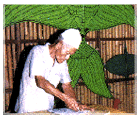
making a wau, bamboo is used for the frame.
The bamboo is split and soaked in mud for two weeks. This
prevents the bamboo from being attacked by weevils as well as
makes it more flexible. The
bamboo splits are made into a complex but lightweight frame,
tested with one layer of paper and making alterations accordingly
to make sure the kite is structurally sound. Next, the patterns
are meticulously cut from rice-paper and glued on piece by piece
to form intricate motifs. In
making a wau, bamboo is used for the frame.
The bamboo is split and soaked in mud for two weeks. This
prevents the bamboo from being attacked by weevils as well as
makes it more flexible. The
bamboo splits are made into a complex but lightweight frame,
tested with one layer of paper and making alterations accordingly
to make sure the kite is structurally sound. Next, the patterns
are meticulously cut from rice-paper and glued on piece by piece
to form intricate motifs.
Apart
from the performance and appearance of the Malay kite, the sound is considered
important as well. The sound created or dengung as it is
called, depends on the force of the wind. The higher the kite
flies and the faster the wind, the higher the pitch, making the
sound ... w-a-u-u-u, w-a-u-u-u.
There
are various types of wau such as wau kuching (cat kite), wau merak
(peacock kite), and wau bulan (moon kite). Each wau also comes
with a different design and size.
 
Wau
Bulan (Crescent Kite)
Named
because of its famous crescent-shaped tailpiece, this kite usually
has a 2.5 metres wing span and height measuring up to 3.5 metres. This
Light and versatile wau bulan is the favorite for
competitions and are made from bamboo and paper. For a winning
kite, a special bamboo, pokok buloh duri, is used.
In
a windy day, a wau bulan can reach a height of more than 450
metres. Malaysian Airline System has chosen it as its logo, to
symbolise controlled flight.
Wau
Sobek
Mostly
used for decorations in many East Coast homes, uses bamboo and
cloth. Cloth is used, as it has a nice texture and appearance but
is simply too heavy to fly.
The
mark of a good kite is one that rises quickly and remains flying, no
matter what the whims of the wind may be.

information - details -
regarding |