|
� Early Malaya � Japanese Occupation � The Malayan Emergency �
Independence �
In the early Christian era,
Malaya was known as far away as Europe. Ptolemy showed it on his early
map with the label �Golden Chersonese�. It spelt gold not only to the
Romans but to others as well. It wasn�t long before Indian and Chinese
traders arrived in search of that most valuable metals, and Hindu mini
states sprang up along the great Malay rivers.
Little is known about prehistoric Malaysia, but around 10,000 years ago
the aboriginal Malays � the Orang Asli began to move down from a
probable starting point in South Western China. The Malay people were
ethnically similar to the people of Sumatra, Java, and even the
Philippines, and from time to time various South East Asian empires
exerted control over all parts of the Malay Peninsula.
 Early Malaya Early Malaya
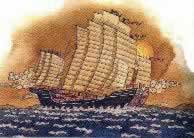
In 1405 the Chinese admiral Cheng Ho arrived in Melaka (Malacca) with greetings
from the Son of Heaven (Emperor) and more importantly, the promise of
protection from the encroaching Siamese from the north. With this
support from China, the power of Melaka extended to include most of the
Malay Peninsula. At about the same time, Islam arrived in Melaka (Malacca) and
soon spread through Malaya.
Melaka�s wealth and prosperity soon attracted European interest, which
came in search of spices. It was the Portuguese who first took over in
1511, followed by the Dutch in 1641 and the British in 1795.
For years the British were only interested in Malaya for its
seaports and to protect their trade routes, but the discovery of tin
prompted them to move inland and eventually govern the entire Peninsula.
Meanwhile, James Brooke, the �white raja�, and the North Borneo Company
made British inroads into Sarawak and
Sabah respectively.
 In
the early 17th century the Dutch established trading bases in Southeast
Asia. The British role on the peninsula began in 1786 when Francis Light
of the British East India Company, searching for a site for trade and a
naval base, obtained the cession of the island of Penang from the Sultan
of Kedah. In 1791 the British agreed to make annual payments to the
Sultan, and in 1800, the Sultan ceded Province Wellesley on the
mainland. In 1819 the British founded Singapore and in 1824 they
formally acquired Malacca from the Dutch. A joint administration was
formed for Penang, Malacca and Singapore, which became known as the
Straits Settlements In
the early 17th century the Dutch established trading bases in Southeast
Asia. The British role on the peninsula began in 1786 when Francis Light
of the British East India Company, searching for a site for trade and a
naval base, obtained the cession of the island of Penang from the Sultan
of Kedah. In 1791 the British agreed to make annual payments to the
Sultan, and in 1800, the Sultan ceded Province Wellesley on the
mainland. In 1819 the British founded Singapore and in 1824 they
formally acquired Malacca from the Dutch. A joint administration was
formed for Penang, Malacca and Singapore, which became known as the
Straits Settlements
The British brought in the Chinese to work in the tin mines and the
Indians to work in the rubber plantations and to build the railways.
In the late 19th century, a number of events led Great Britain to play a
more direct part in the affairs of the peninsula. There was conflict
between Chinese settlers, who worked in the tin mines, and Malays; there
were civil wars among the Malays; and there was an increase in piracy in
the western part of the peninsula. Merchants asked the British to
restore order.
In 1896 Perak, Selangor,
Pahang and Negeri Sembilan were grouped to form
The Federated Malay States, under a resident British general.
Johor
signed a treaty of alliance with Britain in 1885 and accepted a British
adviser in 1914. British control of the four remaining Malayan states
was acquired in 1909 when Siam relinquished its claims to sovereignty
over Kedah, Kelantan,
Perlis and Terengganu (with Johor we now have the Unfederated Malay States).
Japanese Occupation (1941-1945)
By the start of the second world war, Malaya's economy was flourishing
with the output of tin and rubber, giving it great strategic importance.
Malaya fell under threat of a Japanese invasion when the American,
British and Dutch governments froze essential raw materials and oil
supplies to Japan. Japan was then forced to look to Southeast Asia for
shipments. While Britain was preoccupied with defending itself against
he threat of German invasion, the Japanese wasted no time to effect
their occupation of Malaya, commencing with the bombing of the beaches
of Kota Bharu in Kelantan, and Singapore, on 8 December 1941.
The takeover continued almost without opposition as Commonwealth troops
defending Malaya were expecting invasion by sea and not by land. They
were hopelessly and inadequately trained in jungle warfare and lacked
ammunition, so fell to the invaders one by one. Malaya was occupied for
the next three and a half years by the Japanese.
The occupation ended only with the bombings of Hiroshima and Nagasaki in
August 1945. British forces then landed in Malaya and re-established
their authority.
 The
Malayan Emergency (1948-1960) The
Malayan Emergency (1948-1960)
After the defeat of the Japanese in WWII, a new problem emerged for
Malaya. In 1948 Chinese guerrilla fighters (who had been armed and air
supplied by the British during the war) emerged from the jungle and
under Chin Peng, began their terror campaign to take over the country by
force. Thus an intense jungle war began, fought by the British, British
Commonwealth and Malay forces against the Malayan Communist Party.
Lt.-Gen.Sir Harold Briggs was appointed as Director of Operations in
1949. His war executive committees (including Sir Henry Gurney)
coordinated emergency operations, and created 500 new villages for
Malayan citizens who lived in remote areas beyond government protection.
These citizens had lived in constant fear that the Communists would
appear and force them to supply food and money. Travelling was dangerous
as a Communist ambush could lurk behind any roadside bush.
So, by depriving the insurgents of their crucial sources of supplies and
information, the Communists began to attack the new settlements. But the
security forces were now fighting on their own ground, and proved to be
too strong for the Communists. These forces were able to concentrate on
jungle operations, thereby destroying the Communists and their camps.
This was the longest continuous military commitment in Australia's
history. It was to be the only war the West had won against Communism.
The Emergency lasted for twelve years, ending in 1960.
Independence (1957)
In August 1957, Malaya was granted independence from British colonial
rule. With independence, the country became a centralised Federation
with a Constitutional Monarchy. Each state had its own fully elected
State Assembly, its government chosen from the party which had a
majority of elected members in the Asssembly.
Malaya achieved Merdeka (Independence) in 1957, but there followed a
period of instability due to an internal communist uprising and the
external �Confrontation� with Indonesia. In 1963 the north Borneo states
of Sabah and Sarawak together with Singapore, joined Malaya to create
Malaysia.
Indonesian Confrontation (1963-1966)
The Federation of Malaysia (Malaya, Singapore, North Borneo and Sarawak)
came into existence on 16 September 1963. Indonesia had voiced its
strong opposition to the Malaysia plan and immediately severed all
diplomatic ties with Kuala Lumpur, announcing that Indonesia would
"crush" Malaysia. In January 1963 the Indonesians announced a policy of
"confrontation" against Malaya. The confrontation took the form of armed
Indonesian incursions across the borders of Sarawak and North Borneo
from Indonesian Kalimantan. British and Commonwealth forces came to
assist and defend the newly established Malaysia. This was an
"undeclared war", and was largely unpublicised as it was overshadowed by
the Vietnam War.
In 1966 President Sukarno was ousted from power and the new government
was not keen on continuing the confrontation. A signed peace agreement
between Indonesia and Malaysia brought the conflict to an end. The
Philippines also dropped its claim on Sabah and recognised Malaysia.
Meanwhile, political differences had surfaced between Malaysia and
Singapore. On 9 August 1965, Singapore left the Federation and became an
independent nation.
In1969 violent intra-communal riots broke out particularly in Kuala
Lumpur and hundreds of people were killed. The government moved to
dissipate the tensions, which existed mainly between the Malays and the
Chinese.
Moves to give Malays a larger share of the economic pie have led to some
resentment among the other racial groups but, overall, present day
Malaysian society is relatively peaceful and cooperative.

information - details - regarding |
|