|
~ Chinese New Year ~
Festival Date - 23 & 24 FEB 2011
Celebrated by the Chinese
community throughout the world, the festivities is celebrated for 3
days by the busy urban Chinese workers, but as a whole, is
celebrated for 15 days.

Astrologers historically devised the lunar calendar near 300BC during
the rule of Emperor Yao for farmers to know when to plant crops and
harvest them. Based on the phases of the moon, the Chinese New Year
occurs between the winter solstice and the spring equinox, usually
during mid-January to mid-February.

According to legends a monster threatening the Yellow
River civilisation disliked noise, light and the colour red.
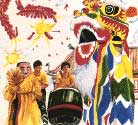
The beast fled when lion dancers performed to the beat of drums and
gongs, homes were lit brightly and many object were painted red.
Houses are normally spring-cleaned and painted and all debts settled
so as to prepare the beginning of the new year.
A week earlier, special attention is given to various household gods.
Offerings of candy, honey and sticky rice cake are made to the Kitchen
God so that he will say sweet things about the family in Heaven. On
the Eve of the New Year, all family members, including those away from
home, are expected to gather for the annual reunion dinner. The first
day of the New Year is usually spent visiting close family members and
relatives. It is the practice of elders and married couples to give
children and the unmarried ang pow � little red packets containing
�lucky money�.
This act is supposed to bestow good luck on both the giver and the
recipient.
 There are also taboos and superstitions. Meals served on the first day
are generally vegetarian as serving meat of slaughtered animals is
considered bad luck. The use of knives and scissors would mean cutting
off good luck, just as the use of brooms would mean sweeping away the
good luck. Any white items are shunned as white denotes bereavement
and is deemed inauspicious. There are also taboos and superstitions. Meals served on the first day
are generally vegetarian as serving meat of slaughtered animals is
considered bad luck. The use of knives and scissors would mean cutting
off good luck, just as the use of brooms would mean sweeping away the
good luck. Any white items are shunned as white denotes bereavement
and is deemed inauspicious.
The Chinese in Malaysia often hold �Open House�, where other races
attend and offer greetings or Gong Xi Fa Chai�. Chinese delicacies and
drinks are served and red ang pows are given to the children.
The second day the families gather to �open the new year�, while at
work bosses treat their employees to a dinner. In Malaysia, this is a
time when Chinese bosses give bonuses even to those employees who are
not Chinese.
The third day is called the �Squabble Day� and is said that if one
visits a friend on this day, one would quarrel or squabble with the
person during this year.
According to tradition, the God of Wealth is welcomed into the
household on the fifth day so as to ensure good fortune all year
round. The seventh day, said to be the day mankind was created, is
deemed �Everyone�s Birthday�.
The Cantonese, mainly in Kuala Lumpur,
Ipoh and Singapore, observe
this �raw and fresh creation� by eating raw fish salad called yue
sang. The eighth and ninth day are devoted to the worship of the God
of Heaven and the Jade Emperor. Kuan Yin, the Goddess of Mercy� is
also offered prayers on New Years Eve, the 9th day and the 15th day of
the first moon.

On the fifth night, called Chap Goh Meh, the Hokkien community in
Penang celebrates in a big way. Unmarried women throw oranges into the
sea to wish for good husbands amid much fun at the Esplanade. The Kek
Kok Si Temple in Air Hitam, Penang, attracts the most pilgrims during the
festivities.
The New Years Celebrations culminate on the 15th day with Shang Yuan
Jie, the Taoist festival that honours the Lords of Heaven, Earth and
Water.
Kuala Lumpur the City almost empties out. The holidays
offer the opportunity for both Chinese and non Chinese to return to
their hometowns or go on holiday.
2008 - Year of the Rat
2009 - Year of the Ox

information - details -
regarding |
|