|
� Cuisine � Where to Eat � Getting There �
Places of Interests �
Capital of Perak
and Self-styled as the City of Bougainvilleas, Ipoh, the third largest
city in Malaysia. The city is unofficially divided into Old Town and New
Town by the Sungai Kinta (Kinta River), from which the city grew. The Old
Town contains most of the colonial buildings.

The name Ipoh is said to have originated from a local tree, pohon epu or
now more commonly known as pokok ipoh. This particular plant is used for
the extraction of poisonous tree sap. The extract is used by the Orang
Asli
(indigenous people) in their blowdarts.
Its geographic location in the rich tin-bearing valley of the Kinta River
made it a natural centre of growth. It grew rapidly as a mining town,
especially in
the 1920s and 1930s.
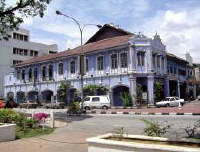 In
the 1950s, Ipoh was characterized night life was unrivalled in peninsular.
it can be rightfully called In
the 1950s, Ipoh was characterized night life was unrivalled in peninsular.
it can be rightfully called
"The Town that Tin Built."
With the collapse of tin prices and the closure of the tin mines in the
late 1970s, Ipoh's growth became stagnated. Being resilient, it later
began to grow in its own unique way with the country's economy. Having
retained much of its charm, Ipoh now reflects the overall progress and
development that Perak is experiencing.
Cuisine
Ipoh is noted for its cuisine. Natives claim that Ipoh's water, which is
relatively hard (high alkali content) owing to Ipoh's location on top of a
large karstic formation, makes the food especially tasty. Here, you can
find people eating relatively heavy meals even for supper.
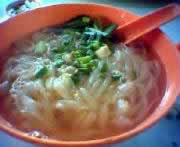 All
sorts of cooking styles can be found here, many of them brought in by the
Chinese from the southern provinces and mixed with local flavours. Ipoh is
particularly famous for food items such as "Sar Hor Fun" (a flat white
rice noodle, best served in soup with shredded chicken meat and prawns), a
variant popular to Ipoh is "Hor Hee", served with fish cakes; "Nga Choi
Kai" (chicken fillet and beansprouts, enjoyed by many visitors to Ipoh); "Hakka
Mee", "Heong Peng", and dim sum (small Chinese dumplings and delicacies). All
sorts of cooking styles can be found here, many of them brought in by the
Chinese from the southern provinces and mixed with local flavours. Ipoh is
particularly famous for food items such as "Sar Hor Fun" (a flat white
rice noodle, best served in soup with shredded chicken meat and prawns), a
variant popular to Ipoh is "Hor Hee", served with fish cakes; "Nga Choi
Kai" (chicken fillet and beansprouts, enjoyed by many visitors to Ipoh); "Hakka
Mee", "Heong Peng", and dim sum (small Chinese dumplings and delicacies).
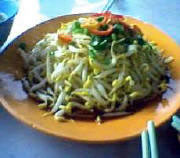 Ipoh
chicken rice with beansprouts is another very popular dish. Ipoh is also
famous for Malay cuisine, such as satay (meat on a skewer which resembles
kebabs, served with peanut sauce), and also tempoyak (preserved durian
extract commonly eaten with chillies). The town is also famous for "Ipoh
white coffee" which is associated with the Old Town. It is a roast of
coffee prepared using a unique method that combines elements of modern
approaches with traditional Malaysian brewing practices. The other Famous
edible products of Ipoh are the Menglembu groundnuts, Kampar Chicken
Biscuits and Chart Tai (Bean Curd Stick). Ipoh
chicken rice with beansprouts is another very popular dish. Ipoh is also
famous for Malay cuisine, such as satay (meat on a skewer which resembles
kebabs, served with peanut sauce), and also tempoyak (preserved durian
extract commonly eaten with chillies). The town is also famous for "Ipoh
white coffee" which is associated with the Old Town. It is a roast of
coffee prepared using a unique method that combines elements of modern
approaches with traditional Malaysian brewing practices. The other Famous
edible products of Ipoh are the Menglembu groundnuts, Kampar Chicken
Biscuits and Chart Tai (Bean Curd Stick).
There are too many dishes to name here but visitors to Ipoh must make it a
point to taste the local food. Chances are the cuisine here is more varied
and tastier than many other places in the country.
Where to Eat
Ipoh is famous for Sar Hor Fun, Hong Kong Chee Cheong Fun, Char Kuey Teow
and Bean Sprouts Chicken. Chinese hawker food can be partaken at the fan
ventilated food court at Jln. Clarke opposite the Excelsior Hotel, the
coffee shops at Lorong Panglima, Wooley Food Centre in Ipoh Garden, and
Old Town Food Centre at Jln. Leech. For excellent Nasi Kandar, go to Medan
Selera Jln Gopeng, Medan Selera Stadium, and the food stalls at Jln. Dato�
Tahwil Azhar (near the children�s playground and the Railway Station. Two
excellent nasi kandar restaurants are on Jln. Kalsom, facing the Tanjung Rambutan Bas Station. Around the Cathay and Lido cineplexes
are numerous restaurants.
Getting There
By road Ipoh is only 205 km (about 2 hrs drive) from Kuala Lumpur and 165
km from Penang. MAS operates domestic daily flights to/ from Ipoh
at Sultan Aziz Shah Airport. Express trains ply along the KL � Ipoh
Butterworth route. Bus services to Medan Kidd in Ipoh are available
from K. Lumpur and Butterworth. For traveling within Ipoh, one can ride in
taxis.
RELATED LINKS
Ipoh ~ Sights & Visits
Sam Poh Tong Temple / The Mekprasit Buddist Temple /
Perak Tong Temple / Darul Ridzuan Museum / F.M.S Bar & Restaurant / Ipoh
Railway Station / D R Seenivasagam Park / Kallumalai Arul Migu Subramaniam
Temple / Ipoh Railway Station / Japanese Garden / Geological Museum of
Ipoh
Ipoh City Area Map
Display of streets, Landmarks and places of
interests

|
|