|
� Taiping Lake Gardens � Taiping Zoo �
Historical Buildings of Taiping �
� A historical walkabout Tour �
Taiping is
Perak�s foremost historical town and was once a thriving mining town and
used to be the capital of Perak. History buffs should not miss visiting
Taiping, 95 km north of Ipoh.
Taiping meaning 'Eternal peace', was anything but. Formerly known as
Larut, it was the scene of bloody feuds between Chinese secret societies
that worked the lucrative tin mines in the 1870's. Even before the
founding of Kuala Lumpur, Taiping prospered and it distinguished itself
by having scored a number of firsts: first museum in the country, the
first zoo, first English newspaper and even the first swimming
pool. Taiping is also the wettest town in Peninsular Malaysia and
receives the average annual rainfall of about 4,000mm as compared to the
peninsula�s average
of 2,000mm � 2,500mm.
 Taiping
Lake Gardens Taiping
Lake Gardens
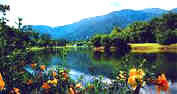
Taiping's disused mining pools have been cleverly turned into the
beautiful and famous Taiping Lake Gardens. This 62 hectare park is one
of the most beautiful parks in the country. It offers lush greenery, a
beautiful lake and a colourful profusion of flowers sculptured around
two lakes. Facilities available includes a rest house,
fishing and aqua-biking.
Taiping Zoo
Located within is the Taiping zoo, the only zoo in the northern region
of Peninsula Malaysia and also the oldest zoo in Malaysia.
Officially known as Taman Mergastua Sultan Idris Shah, it covers an area
of 34 acres. Here you can treat yourself to the exotic sights and sounds
of some of Malaysia's wild animals in an enclave of natural settings
with streams, lakes and abundance of flora.
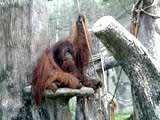 There
are 1300 animals of 180 species including birds, reptiles and mammals
can be witnessed in the natural-looking enclosures. Among the wildlife
here are the endangered species such as the whitehead eagle (Brahmini
Kita/Halistur Indus), honey bears (Helactus Malayanus), black panthers,
Orang Utans, the Malaysian elephants and tigers. There are also a host
of animals from foreign lands including the African lions. To create an
environment that is sensitive to the animals' natural habitat, Taiping
Zoo is gradually introducing new open concept enclosures. One of the
best managed zoos in the country, it offers Night Safari visit, which
allows visitors to observe nocturnal animals from There
are 1300 animals of 180 species including birds, reptiles and mammals
can be witnessed in the natural-looking enclosures. Among the wildlife
here are the endangered species such as the whitehead eagle (Brahmini
Kita/Halistur Indus), honey bears (Helactus Malayanus), black panthers,
Orang Utans, the Malaysian elephants and tigers. There are also a host
of animals from foreign lands including the African lions. To create an
environment that is sensitive to the animals' natural habitat, Taiping
Zoo is gradually introducing new open concept enclosures. One of the
best managed zoos in the country, it offers Night Safari visit, which
allows visitors to observe nocturnal animals from
8:00 to 11:00pm all year round.
Visiting hours are from 8:30am -
6:30pm daily, including public holidays.
For the latest information on Taiping Zoo, visit its official website at
http://www.zootaiping.gov.my
Historical Buildings of Taiping
These buildings include - The Taiping Government Offices (built in
1895), Hokkien Association (1931), Police Station (circa 1900), Taiping
Public Library (1881), all on Jln. Kota; King Edward VII School (1883)
and St. George�s Institution (1915), both at Jln. Stesyen; Old Saints
Church (1886), Fort Carnavon (1887), Taiping Goal (1879), Malay States
Guides Barracks (1880s) and the Perak Museum (1903), all on Jalan Taming
Sari.
The centre of Taiping is quite small so you will be able to cover most
of the interesting buildings on foot. It is an excellent way of
exploring the historical aspects of the town with a walkabout tour of
its well preserved heritage buildings that hark back to a bygone era..
A Historical Walkabout Tour
Turn left and proceed to the end of Jalan Taming Sari and make a hairpin
turn into Jalan Kota. Proceed northwards look out for the Hokkien
Association Building. Built in 1931, it served as a clan house of the
early settlers who migrated from Fujian province in China. Another fifty
metres further away at the junction of Jalan Masjid and Jalan Kota
stands the Masjid Lama (old Mosque). Dating back to 1887, the grounds
house the mausoleum of a Muslim scholar named Sheikh Makhbuli.
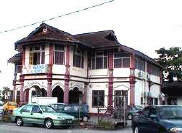 Turn right at the first junction. to head to Jalan Idris and proceed to
the Peking Hotel. The structure built in 1929, was once the premises of
the Taiping rubber dealers association and sisplays rare trefold arches
and narrow vertical windows. Turn right at the first junction. to head to Jalan Idris and proceed to
the Peking Hotel. The structure built in 1929, was once the premises of
the Taiping rubber dealers association and sisplays rare trefold arches
and narrow vertical windows.
Backtrack to Jalan Kota and head north towards the junction of Jalan
Kota and Jalan Iskandar. Here turn left into the tree lined Jalan Pasar.
Here the Tseng Lund Hakka Association building, resembling a temple,
stands proudly since its construction in 1887. From here the Taiping
Market, a relic of a bygone era, should already be beckoning you.
Consisting of two buildings, the old and the new, the former made of
ironwood timber and covered by iron sheet roof was built in 1884.
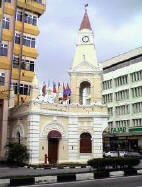 From Jalan Pasar get back on Jalan Kota to visit the
Police Station. A
timber building constructed in 1881, with its present structure
completed in 1936, it is topped with a fortified clock tower and once
served as a fire station (the first fire brigade of the Federated Malay
States). Proceed to Jalan Sultan Abdullah where the well preserved
building at No.19 still continues to serve as the premises of a trading
company. In the 1930's, the building was a cigar factory built by a
Burmese merchant who brought in Burmese women to roll cigars. During the
Japanese occupation it functioned as a warehouse for military supplies.
At Jalan Tokong stands the Cantonese Association and the Temple for the
Immortal Girl within a common compound. Founded in 1887, the association
was set up to preserve the interest of early immigrants from Kwangtung
province in China. From Jalan Pasar get back on Jalan Kota to visit the
Police Station. A
timber building constructed in 1881, with its present structure
completed in 1936, it is topped with a fortified clock tower and once
served as a fire station (the first fire brigade of the Federated Malay
States). Proceed to Jalan Sultan Abdullah where the well preserved
building at No.19 still continues to serve as the premises of a trading
company. In the 1930's, the building was a cigar factory built by a
Burmese merchant who brought in Burmese women to roll cigars. During the
Japanese occupation it functioned as a warehouse for military supplies.
At Jalan Tokong stands the Cantonese Association and the Temple for the
Immortal Girl within a common compound. Founded in 1887, the association
was set up to preserve the interest of early immigrants from Kwangtung
province in China.
A pair of lions, which are installed in 1954, guards the front
courtyard. Inside the same compound , you will find the Temple for the
Immortal Girl, built around 1940's and is dedicated in the deity Ho
Sien-ku Miao. Turning left into Jalan Kota, at the end of which is the
Public Library. Housed in a whitewashed building with a pillared porch
that was constructed in 1882, it was the former premises of the
Chartered Bank of India, Australia and China, which later
became Standard Chartered Bank.
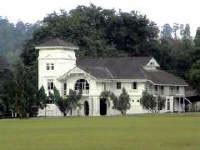 A leisurely stroll from there brings you to Jalan Esplande, which meets
Jalan Kelab Baru. Here, near the base of a hillock are two Chinese
tombstones dating back to mid 1880's. Atop the hillock stands the
District Officer's residence. Built in 1890's it was once the home of
the Secretary to the British Resident. Continue another 10 minutes to
the former British Officers Mess. A right turn leads to Jalan Taming
Sari where the All Saints Church is located. Founded in 1886, as the
first Anglican Church in the Federated Malay States, the churchyard
contains the graves of early British settlers, mostly having succumbed
to malaria. A leisurely stroll from there brings you to Jalan Esplande, which meets
Jalan Kelab Baru. Here, near the base of a hillock are two Chinese
tombstones dating back to mid 1880's. Atop the hillock stands the
District Officer's residence. Built in 1890's it was once the home of
the Secretary to the British Resident. Continue another 10 minutes to
the former British Officers Mess. A right turn leads to Jalan Taming
Sari where the All Saints Church is located. Founded in 1886, as the
first Anglican Church in the Federated Malay States, the churchyard
contains the graves of early British settlers, mostly having succumbed
to malaria.
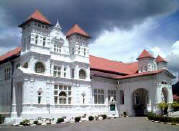 The grand finale is the
Perak Museum at the end of Jalan Taming Sari.
First opened in 1883, it is the oldest museum in the ountry. It houses
an impressive collection of weapons, aboriginal implements, ornaments,
and archeological treasures. Also on display are artifacts from Perak�s
rich historical culture and heritage. There is even the skull of an
elephant that charged a train The grand finale is the
Perak Museum at the end of Jalan Taming Sari.
First opened in 1883, it is the oldest museum in the ountry. It houses
an impressive collection of weapons, aboriginal implements, ornaments,
and archeological treasures. Also on display are artifacts from Perak�s
rich historical culture and heritage. There is even the skull of an
elephant that charged a train
in the 1950's.
The statue of Colonel Walker, considered the father of the Malay States
stands in front of the museum. Opposite the museum is Fort Caranavon,
built in 1885, which is now a prison. Named after the Earl of Carnarvon,
Secretary of State for the colonies, it was once used as a
rehabilitation centre for captured communists during the Emergency years
(1948-1960).

|
|