|
Tambun Cave Paintings
The caves bear 2,000-year-old paintings dating back to the Neolithic era
depicting the life of early inhabitants of the peninsula. For such a
significant historical site, it has been ashamedly left obscure and
relatively hard to locate. To get to the cave, you will need a good pair
of walking shoes and have to climb a flight of relatively steep concrete
141 steps overgrown with weeds and leaves. A smooth limestone cliff
overhangs the ledge.
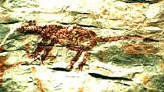 On
this white stone, 20 feet or more above the ledge, are a number of
paintings of wildlife, people and abstract designs. Gua Tambun is believed
to be one of the caves in Malaysia with hematite (iron oxide) drawings.
Discovered by Lt. R.L Rawlings of the 2nd Battalion, 6th Q.E.O Gurkha
Rifles in 1959 while on a routine patrol in the area, he unearthed one of
the greatest finds in Malaysian History. On
this white stone, 20 feet or more above the ledge, are a number of
paintings of wildlife, people and abstract designs. Gua Tambun is believed
to be one of the caves in Malaysia with hematite (iron oxide) drawings.
Discovered by Lt. R.L Rawlings of the 2nd Battalion, 6th Q.E.O Gurkha
Rifles in 1959 while on a routine patrol in the area, he unearthed one of
the greatest finds in Malaysian History.
There are 30 forms of paintings on the wall, which include human, abstract
and animal designs depicting their surroundings. A few of them were about
3m across. The paint is dark purple, in others, dull red. Some of the
figures are obviously men, rather crudely drawn. Some of the animals are
easily identified,
others are rather vague.

But most of the paintings are quite clear; there are wild boars and a
dugong, a tapir and some deer. The deer are particularly interesting, they
all have the appearance of pregnant does, and one even has a small infant
drawn inside its swollen belly! At one time, this gallery of pictures
extended for more than a hundred feet, but time and the weather have
obliterated a large portion of it.
However, enough remains to prove that at one time men living in Lembah
Kinta, although primitive, were able to illustrate their lives rather
vividly. Intriguing enough, there are even seashells found at the base of
the 'cave', signifying that the area was once, in all probability filled
with and surrounded by sea water, but this would have been thousands of
years ago. The cave also contained some Neolithic artifacts but have since
been removed.
The signboard put up by the Museums Department had also been defaced. The
site is in danger of erosion due to inadequate protection. It is our hope
that the proper authorities take note be it state or federal and it does
not become another act of doing too little too late.
To get there - exit on the Ipoh highway entrance, you should be able to
notice signboard to Tambun. The caves signboard is small, hard to make
out. Make sure you ask local residents for direction. The distance is
approximately 10km out of Ipoh city centre.
Kuala Gula Bird Sanctuary
Kuala Gula in the north west of Perak, is home to many migratory and
Malaysian birds. There are approximately 166 species that can be found in
this protected sanctuary. Kuala Gula is a stopover for various species of
birds when they migrate from the North to South Hemisphere especially from
Siberia and Mongolia. During the migration season between August and April
every year, more than 200,000 migratory birds representing some 50 species
stop over here. The numerous species include Mycteria Cinerea and the
Laptopilos Javanicus which are from Siberia.
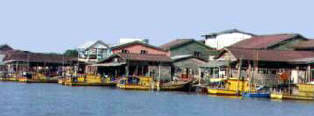 Kuala Gula itself is a a fishing settlement in the Kerian District,
located on the coastline of Perak, approximately 50 km to the west of
Taiping. It is part of the Forest Reserve, which is actually a mangrove
swamp area. - The Matang Mangrove Forest, covering 40,000 hectares, which
is the largest stand of mangrove ecosystems in Peninsular Malaysia. These
ecologically abundant mangrove habitats stretch along the west coast tidal
mudflats of northern Perak for almost 50km plus another 40km along the
shorelines of the sheltered river systems within the reserve's five
estuaries. Kuala Gula itself is a a fishing settlement in the Kerian District,
located on the coastline of Perak, approximately 50 km to the west of
Taiping. It is part of the Forest Reserve, which is actually a mangrove
swamp area. - The Matang Mangrove Forest, covering 40,000 hectares, which
is the largest stand of mangrove ecosystems in Peninsular Malaysia. These
ecologically abundant mangrove habitats stretch along the west coast tidal
mudflats of northern Perak for almost 50km plus another 40km along the
shorelines of the sheltered river systems within the reserve's five
estuaries.
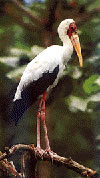 Over 160 species have been spotted, including the Milky Stork,
Flowerpecker, Wood sandpiper, Gull-billed Tern, Brahminy Kite, plovers and
the White-bellied Sea-eagle. The abundance of water birds in these areas
has made Kuala Gula prominent both locally and internationally, especially
to bird watchers. Over 160 species have been spotted, including the Milky Stork,
Flowerpecker, Wood sandpiper, Gull-billed Tern, Brahminy Kite, plovers and
the White-bellied Sea-eagle. The abundance of water birds in these areas
has made Kuala Gula prominent both locally and internationally, especially
to bird watchers.
Many visitors both local and overseas from United
States, Australia, Europe, Japan and other countries had visited Kuala Gula to watch these birds.
Beside birds, several species of mammals such as squirrels, rats, bats,
otters, Silver-leaf Monkey, Long-tailed Macaques, wild pigs, Bottle-nosed
Dolphin, Ridge-backed Dolphin, Leopard Cat and civets were also observed
in these areas. Reptiles such as Water Monitor Lizard, Clouded Monitor
Lizard, Python, and mangrove snakes
are common here.
Visit the Bird Conservation Project Interpretation Complex to get a host
of information on the project birds and other animals. The best time to
visit is between September and December, when thousands of birds can be
seen in the area. Boating trips are available either from Kampong Gula or
Kuala Kurau.
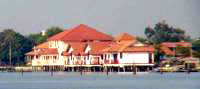 Several government resthouses and chalet are available for visitors
intending to visit the sanctuary. There are ten moderately priced chalets
for those who wish to stay at Kuala Gula. Several government resthouses and chalet are available for visitors
intending to visit the sanctuary. There are ten moderately priced chalets
for those who wish to stay at Kuala Gula.
Location: About180km from K. Lumpur on the North South Highway, about 38km
from Taiping via the Kamunting exit.

|
|