|
� Central Market - Pasar
Payang � Bukit Puteri (Princess Hill) � Istana Maziah (Maziah Palace) �
Terengganu State Museum �
Central Market - Pasar Payang
Located just by the Sungai Terengganu (Terengganu River), one can find
everything local and exotic in this massive market cum shop building.
Consisting of a wet market and a shopping arcade, it offers fruits,
vegetables, fish, batik, brassware, brocade, songket and handicrafts.

A vast choice of traditional textiles can be purchased on the first floor
of the Central Market. Rattan baskets and farmers� hats are also popular.
Silk garments handkerchiefs, batik shirts, scarves and kaftans can be
bought here. Apart from that, you can get fresh produce of local
delicacies such as the 'keropok lekor', Bartering is totally expected -
thirty percent off the marked price is possible and forty is a steal. If
you smile you may even get more
Visit Rating -

Bukit Puteri (Princess Hill)
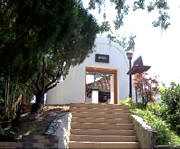
Atop this 200 m high historical hill which offer a view of the town, are
the remains of a small fortress. Visitors to the hill will be able to
trace the remnants of the fort, such as a big bell to signal danger, four
cannons, a flagpole, a lighthouse, graves and the defence wall. It also
provides a panoramic view that encompasses the city limits, its silky
shores and tropical islets that lay beyond.
 During
the year 1830, there was a struggle for power among the two royalty of
Terengganu that is, Tengku Mansur, the Sultan of Terengganu who was
conferred the title of Sultan Mansur Shah II and Tengku Omar, the Yang Di
Pertuan Besar. Tengku Omar built the fort at the top of Bukit Puteri for
defence. The fort was built of bricks and cemented with honey, lime and
egg white. However Bukit Puteri was captured by Sultan Mansur Shah II and
Tengku Omar was forced to flee to Besut. In 1839, Tengku Omar successfully
recaptured the fort after 3 attempts. He spent much of his early days as
the ruler of Terengganu with his generals on a raised platform called a 'singgahsana'
as seen still at the fort. Also to be seen here is a large bell. It was
believed that the bell was guarded by a boy from the royal family. The boy
job was to sound the bell as an alarm in times of emergency or danger.
Made from yellow copper, it was commissioned during the reign of Sultan
Zainal Abidin III in the year 1908. During
the year 1830, there was a struggle for power among the two royalty of
Terengganu that is, Tengku Mansur, the Sultan of Terengganu who was
conferred the title of Sultan Mansur Shah II and Tengku Omar, the Yang Di
Pertuan Besar. Tengku Omar built the fort at the top of Bukit Puteri for
defence. The fort was built of bricks and cemented with honey, lime and
egg white. However Bukit Puteri was captured by Sultan Mansur Shah II and
Tengku Omar was forced to flee to Besut. In 1839, Tengku Omar successfully
recaptured the fort after 3 attempts. He spent much of his early days as
the ruler of Terengganu with his generals on a raised platform called a 'singgahsana'
as seen still at the fort. Also to be seen here is a large bell. It was
believed that the bell was guarded by a boy from the royal family. The boy
job was to sound the bell as an alarm in times of emergency or danger.
Made from yellow copper, it was commissioned during the reign of Sultan
Zainal Abidin III in the year 1908.
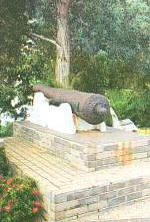 Many
of the original canons were taken back to Siam (Thailand) by the Siamese
when they ruled Terengganu from 1843-1845 The cannons were believed to
have originated from Spain, Portugal and the Malay States and were given
names such as Seri Jamlor, Seri Buih, Seri Johor and Laila Majnun. Many
of the original canons were taken back to Siam (Thailand) by the Siamese
when they ruled Terengganu from 1843-1845 The cannons were believed to
have originated from Spain, Portugal and the Malay States and were given
names such as Seri Jamlor, Seri Buih, Seri Johor and Laila Majnun.
Also known as Princess Hill, It is named after a Fairy Princess. According
to legend, Bukit Puteri was said to have originated as a place of
residence for Puteri Bunian. However, the princess left Bukit Puteri when
the local residents borrowed her cutlery and did not return them to her A
cave known as Gua Puteri can also be found here. It was used as a place to
keep the gun powder, stone and iron bullets. The 18 meters high. flag pole
that is on top of Bukit Puteri was used to raise the royal flag when there
were any royal ceremonies held. The lighthouse on the peak of Bukit Puteri
functioned as a guide for fishermen and sailors that sailed into Kuala
Sungai Terengganu. During the reign of Tengku Umar, he built a palace
called the Green Palace at the foot of Bukit Puteri but was burned down in
1882. He built a new palace near the site of the Green Palace and was
named Istana Maziah which still exit until today.
Best time to visit the fort in the morning or evening time when
temperature is not too extreme. From the platform at the top, you can see
fishing boat coming back home after a hard day.
Location � Just beside Istana Maziah
(Maziah Palace) and less than
5 minutes walk from Pasar Payang.
Visit Rating -

Istana Maziah (Maziah Palace)
Built n 189,during the reign of Sultan Zainal Abidin Ill, Istana Maziah
was built to replace the Istana Hijau that was burned down which was
burned down during World War II. Believed to have been built by 20
craftsmen using limestone mixed with clay, coarse salt, egg yolk and
honey, Its architecture is a blend of the old and the new.

The palace has tall shuttered windows that resemble a French chateau.
Located near the Terengganu river mouth, it is used for royal ceremonies
only such as for royal birthdays and weddings, conferring of titles, and
receptions of dignitaries.
Located in front of Istana Maziah, Dataran Maziah is a mini-park
beautifully adorned with landscapes of shrubs, trees and paved walkways.
In the centre of the park, stands an impressive replica of Betel Chewing
instruments such as Gobek Sireh and Kacip Pinang, symbolising the culture
and traditions of the state. This is however not a place where you can
just walk in and take a photo.
Location � Jln Sultan Zainal Abidin
next to Bukit Puteri.
Visit Rating -
Terengganu State Museum Complex
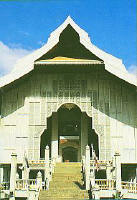
A priceless historical relic, the "batu bersurat" which is regarded as the
earliest written testimony of the existence of Islam in Terengganu, greets
visitors at the main building. The main building is an artifact in its own
right, is built on 16 stilts with Malay and Thai influences.
 Covering
over twenty-seven lush hectares, the Terengganu State Museum is the
largest in South East Asia. The complex houses ten galleries, a fisheries
museum, a maritime museum four traditional palaces, a botanic garden and a
herbal garden. Covering
over twenty-seven lush hectares, the Terengganu State Museum is the
largest in South East Asia. The complex houses ten galleries, a fisheries
museum, a maritime museum four traditional palaces, a botanic garden and a
herbal garden.
Pathways lead to maritime and fisheries archives, as well as a display of
traditional houses where we glimpse into lifestyles from the past. The
focal point, though, is the museum�s main building, and behind its stilted
Islamic exterior are ten unique galleries showcasing everything from
historical crafts to contemporary arts. The ten galleries are devoted to
the history of the state and displays of fabrics, Islamic calligraphy and
various handicrafts.
Location � Bukit Lesong / Visit
Rating -


travel - guide - sightseeing - information - travel guide - tours - visitors guide
- places of interest |
|

