|
� History � People & Culture � Handicrafts � Climate
& Weather � Travel Tips �
History
Terengganu's history goes back to as far as the 1st century and has long
been an important area of Malay settlement. Throughout the time up to the
present day, Terengganu has been ruled by 16 Sultans.
Terengganu's location on the South China Sea ensured that it was on trade
routes since ancient times. The earliest written reports on the area that is
now Terengganu were by Chinese merchant seamen in early centuries A.D. Under
the influence of Sri Vijaya, Terengganu also traded extensively with the
Majapahit Empire, the Khmer and the Chinese. Like other Malay states,
Terengganu practiced a Hindu�Buddhist culture combined with animist
traditional beliefs for hundreds of years before the arrival of Islam.
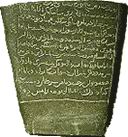 Terengganu
was perhaps the first Malay state to receive Islam, as attested to by a
stone monument dated 1303 with Arabic inscriptions found in Kuala Berang, in
the district of Ulu (inland) Terengganu. Terengganu became a vassal state of
Melaka, but retained considerable autonomy with the emergence of Riau-Johor. Terengganu
was perhaps the first Malay state to receive Islam, as attested to by a
stone monument dated 1303 with Arabic inscriptions found in Kuala Berang, in
the district of Ulu (inland) Terengganu. Terengganu became a vassal state of
Melaka, but retained considerable autonomy with the emergence of Riau-Johor.
Terengganu emerged as an independent sultanate in 1724. The first Sultan was
Tun Zainal Abidin, the younger brother of a former sultan of Johor, and
Johor strongly influenced Terengganu politics through the 18th century. In
the 19th century, Terengganu became a vassal state of Siam, and sent tribute
every year to the Emperor of Siam in the form of bunga mas (a tree with
flowers and leaves made of gold). Under Siamese rule, Terengganu prospered,
and was largely left alone by the authorities in Bangkok. The terms of the
Anglo-Siamese Treaty of 1909 saw the transfer of power over Terengganu from
Siam to Great Britain. A British Resident was installed in 1919, and
Terengganu become one of the Unfederated Malay States. The move was highly
unpopular locally, and in 1928 the British used military force to suppress a
popular uprising. During World War II, Japan transferred Terengganu back to
Siam, along with Kelantan, Kedah, and Perlis, but after the defeat of Japan,
these Malay states were returned to British control. Terengganu became a
member of the Federation of Malaya in 1948, and a state of independent
Malaya in 1957.
People & Culture
Terengganu's population, which stands at approximately 2 million people,
consists of 95% Malays, 2.6% Chinese with the rest being made up of Indians
and others. Terengganu did not receive many Indian or Chinese migrants, and
therefore Malay cultural influences predominate. Thus Terengganu always had
a reputation for being socially conservative and deeply Islamic in religion.
Traditional pursuits such as kite-flying contests, top-spinning contests,
and traditional arts & crafts, such as batik and songket are still very much
alive.

Here there are Homestay's available that gives an opportunity to live with
host families and to get a fist hand experience of a Malay village lifestyle
and activities like going to orchards to harvest fruits, feeding livestock
in the farm or playing Malay traditional games like congkak, kite flying,
etc.
Another fun way is to go on the river cruise which allows one to witness the
traditional live style of the Terengganu villagers, and their several
cottage industries.
Climate & Weather
Tropical climate, with daily temperatures ranging from 22�-33�C, and
relative humidity between 80-87%. May is usually the hottest month and
January the coolest.The northeast monsoon rains in the states of Terengganu
and Kelantan usually begin after the first week of November and are
characterized by heavy rain spells lasting 2-3 days duration accompanied by
strong winds and rough seas. Usually there will be a few of these rain
spells, bringing rainfall up to 615 mm in December versus 120 mm in April.
Travel Tips
Weekends & Holidays
Apart from the resort operators, many of the shops are closed by 5.30pm and
most do not open on Fridays as the weekends here falls on Fridays &
Saturdays. During public holidays, school holidays and the long weekends,
are peak seasons and resort bookings may not be available, unless it is made
early. Prices vary and tend to go up especially at the popular resorts.
Conservative Islamic
Being socially conservative and Islamic, conservative attire in public
places is a common courtesy and alcohol availability is limited.
Cash & Credit Cards
Credit cards are generally not accepted, except at certain resorts and
establishments. Similarly, ATM machines are not so widely available except
at the bigger towns. Better to have ready cash in hand

travel - guide - sightseeing - information - travel guide - tours - visitors guide
- places of interest |
|

