|
Situated about 30km from Bintulu
Town, the Similajau National Park with long sandy beaches, geological
formations and rainforest treks, offers a host of activities from trekking
to bird watching and coastal and river cruises
 The
Park The
Park
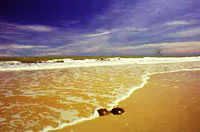
It consists of a narrow shoreline dominated by many small inlets (crystal
clear fresh water streams, many cascading down from small waterfalls right
onto the beach sand) and unspoilt golden sandy beaches. The beach runs for
some 25km along the gently meandering coastline, punctuated by rocky
headlands. On weekends, it bursts to life as Bintulu folks come to enjoy a
short break.

Flora and Fauna
The park boasts 24 Recorded species of mammals, such as gibbons, banded
langurs and long-tailed macaque. The Park records the presence of 185
species of birds, which include hornbills and migratory water birds like
Storms Stork. A very noteworthy reptile found here is the Saltwater
Crocodile. Lucky visitors may be able to sight dolphins out amongst the
waves.
Trekking allows you to see the changing scenes between two types of forest
here. In the dipterocarp forest, you see huge, majestic trees like meranti,
keruing and kapur dominating the landscape. In the heath forest, the scene
is strikingly different. Smaller trees dominate instead, like the selunsur
trees with reddish bark, insect-eating pitcher plants and wild orchids.
These can be found along the streams in the park. Guides will show you
where the huge estuarine or salt water crocodiles bask in the sun or where
green turtles come ashore to lay their eggs.

 Turtle Beach is so named because turtles come there to lay eggs. Three
common species recorded are the Green turtle (Chelonia mydas), Leatherback
turtle (Dermochelyes coriacea), and Hawksbill turtle (Eretmochelys
imbricate). They come during the month of March to September annually.
They leave behind tell-tale signs of track and depressions on the sand.
Visitors are advised that turtles are totally protected animals and that
it is an offence to disturb them or their eggs. Turtle Beach is so named because turtles come there to lay eggs. Three
common species recorded are the Green turtle (Chelonia mydas), Leatherback
turtle (Dermochelyes coriacea), and Hawksbill turtle (Eretmochelys
imbricate). They come during the month of March to September annually.
They leave behind tell-tale signs of track and depressions on the sand.
Visitors are advised that turtles are totally protected animals and that
it is an offence to disturb them or their eggs.
There are two species of riverine crocodiles exist in the park. They are
False Gharial (Tumistoma schlegii) and an estuarine crocodile (Crocodylus
porousus). The former is harmless while the latter is dangerous
King Crabs also visit the area during the dry season starting from early
May to October. They usually come in pairs, being the males on top of the
females. The males are smaller in sizes as compare to the females. They
come to the shore to lay eggs. During this breeding season you will also
see plenty of catfishes coming to feed on the eggs.
Accommodations
Park accommodations are available and include single lodges, double storey
chalets (suitable for a small group of four at one time.) as well as
hostel
with double-bunker beds.
RELATED LINKS
Sarawak ~ National Parks
View all various national parks located throughout Sarawak. These parks
which within reach from Miri, Bintulu and Kuching offer visitors an
excellent collection of flora and fauna. They contain abundant wildlife,
lakes, waterfalls, exotic plant species, secluded beaches and jungle
treks.
|
|

