� Tanjung Kubong Tunnel & Coalmining �
The Chimney � Labuan Bird Park �
� Botanical Gardens � Layang-Layangan Beach � Pancur Hitam Beach �
 Tanjung
Kubong Tunnel & Coalmining Tanjung
Kubong Tunnel & Coalmining
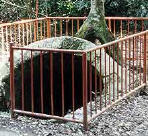
The northern tip of the island is called Tanjung Kubong. An expansive
network of underground tunnels and deep wells are found in this area.
This is the site of coal mining, which started in 1847. The mine was
operated by various British companies for 64 years. The last one, the
New Central Borneo, installed an 8 mile long railway track to Victoria
Port to facilitate the export of the coal. A series of mining accidents
led to the closure of the mine in 1911. The area is dotted with pits and
tunnels. Old bricks and pieces of rail tracks and rusted cables can
still be seen strewn on the ground. One can actually enter a low tunnel
with the help of a short rope and emerge from the top. Across the road
next to the Chimney, is a vertical well. It is 10 feet wide and
measuring some 100 feet deep. At the bottom of this well are found
entrances of more tunnels, which are yet to be explored.
 The
Chimney The
Chimney
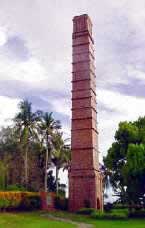
A well-known landmark, this 106 feet high structure was built in the
1800�s. Believed to be a relic from the old coal mining days of Labuan
during 1847 to 1912. The Chimney appears square shaped with an inner
hollow structure is made from more than 23,000 pieces of red bricks. The
bricks layering and works are typical of British style. The �Chimney�
was long thought to be nothing more than a ventilation shaft. However,
recent findings revealed that there were no traces of smokes or burning
to suggest its use as a chimney as popularly believed. Careful digging
has revealed at least 12 layers of bricks beneath the surface. The
structure sits firmly on a large tract of limestone rock containing rich
kaolin or porcelain clay, which provided the strong foundation.
It iis still very much a mystery until today. Various hypothesis has
been put forward to its purpose. Some said it was an unfinished mansion.
While others said it was a light house beaconing passing ships. In its
heyday, a thriving settlement was built at the sea front area below the
Chimney. It was then used as a bell tower to announce the arrival of
ships to the residents below. It has become an intriguing riddle that
fascinates locals and visitors alike.
Location - Tanjung Kubong
Labuan Bird Park
Located near the Chimney at Tanjung Kubong. It has three large
dome-shaped cages surrounded by surrounded by beautiful trees and
flowering plants. The park is home to many species of Borneo birds most
likely to be encountered by bird watchers. A slow, relaxing walk within
the bird park is recommended to take in the beauty and marvel at a large
variety of tropical birds from around the region.

There are plans to collect a good percentage of the 580 species of birds
found in Borneo�s diverse habitats, from mangroves along the coast to
forest in the mountains. Unlike bird watching in the wild, here at the
bird park, Much bird watching can be done without the arduous treks in
the jungle or any need to tow expensive equipment. All you require is a
notebook to jot down what you see and a pair of good binoculars. Help in
identifying birds can be obtained from the park. Entrance to the park is
free.
Location - On the northern end of
Labuan island,
accessible via Jalan Tanjung Kubong
Botanical Gardens
The Labuan Botanical Garden is a charming garden with an equally
charming story behind it. It is a recreational park with majestic old
trees and beautiful landscaping.
 It
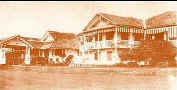
was formerly the site of the Government House which was built in 1847
was locally known as Bumbung 12. It was believed that Hugh Low, the
Colonial Secretary for many years did much of the early work on the
Garden. Many of the older trees were planted by him. The house however
was completely destroyed during the War. It
was formerly the site of the Government House which was built in 1847
was locally known as Bumbung 12. It was believed that Hugh Low, the
Colonial Secretary for many years did much of the early work on the
Garden. Many of the older trees were planted by him. The house however
was completely destroyed during the War.
On the grounds can be found two graves with tombstones dating back to
1847 may also be found here; these graves, said to be the oldest on
Labuan, were relocated here to protect them from the tides along the
coast.

One of the two graves relocated was that of Commander James A. Gordan of
HMS Wolf, present at the handing over of Labuan to the British on
December 24, 1846 and who assisted in the construction of the grounds.
the other is a small grave of a much-loved foxhound named 'Jim'.
Of this era, today, only the old water storage tank remains.
The Labuan Botanical Garden is
located behind the old airport, about 2km east of Labuan town and is
accessible via Jalan OKK Abdullah.
Layang-Layangan Beach
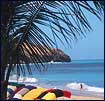
A golden beach, brilliant sunshine and waves gently lapping - this is
the reason why Layang-Layangan beach is an extremely popular spot
especially so on weekends. Cycling paths and picnic tables are shaded by
leafy trees. In this area too can be found many food stalls with live
musical bands performing every weekend. Horse riding and cycling are
some of the popular leisure activities on this beach. The Peace Park and
Manikar Beach Resort are also nearby.

Pancur Hitam Beach
This is one of the most developed beaches in Labuan. A beautiful
landscaped park extends directly onto the long sandy beach.
Located at the north shore of Labuan, Pancur Hitam beach is home to
Labuan's biggest and most luxurious private house - the "House of
Millions of Peace". The roads nearby this house, Jalan Batu Manikar and
Jalan Pancur Hitam, are tastefully designed with well landscaped and
decorated pathways.
Just in front of the house, rows of local market stalls offer treats
including fresh coconut water, chicken wings, popcorn and other
mouth-watering local cuisines and knick-knacks. Right at the side of the
house, there is a small natural path that will lead you to Bukit Pohon
Batu (Pohon Batu Hill), the second highest peak in Labuan, where you can
enjoy a jungle trekking jaunt. From this high vantage you can also have
a bird's eye view of the entire Labuan island.
Further south of Pancur Hitam beach, you will find a recreational area
known as the "Sudut Cabaran" (Challenging Site), which offers an ideal
site for various recreational activities including picnic and camping.
Towards the evenings, you can take in a breathtaking sunset with the
three peaks of Phin Batu Hill as a dramatic backdrop.
|
|