|
� History � Cuisine �
Getting There �
History
Kelantan boasts of a historical past that date as
far back as prehistoric times. During the early Chinese era, Kelantan
was influenced by the Indianized Funan Kingdom of the Mekong River. In
fact, farming methods used in Kelantan are based on Funan practices.
Even the wayang kulit (shadow puppet
show), a popular form of entertainment, and weaving methods are thought
to have come from Funan. Kelantan has gone on to become vassals for the
Sumatran Sri Vijaya Empire and the Siamese. Kelantan was known from
earlier times as a seat of powerful kingdoms that established trading
links with the Chinese Empire which referred to
Kelantan as Ho-Lo-Tan
In the 15th Century, it came under the Melaka Sultanate. It was further
ruled by the sultanates of Johor and Terengganu. By the 1820s, Kelantan
was one of the most prosperous states in the Peninsula as there were
unlimited development.

The state has at various times been
a vassal of Siam. In the 18th century, a Kelantanese prince, Long Yunus,
ascended the throne and the present-day royal family is descended from
him.
Kelantan also retained strong ties with Siam throughout the 19th Century
before control was passed on to the British after the signing of the
Anglo-Siamese Treaty in 1909. By 1948, Kelantan along with the other
states of the Malay Peninsula formed the Federation of Malaya, which
gained independence on
31st August 1957.
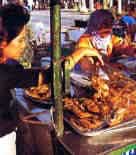 Cuisine Cuisine
Kelantan boasts its own unique cuisine with many popular dishes such as
Ayam Percik, Nasi Kerabu and Nasi Dagang. Ayam Percik is barbecued
chicken marinated with rice, and spicy coconut gravy. Nasi Kerabu, is
rice based dish served with coconut milk, flaked fish, desiccated
coconut and a variety of herbs, spices, and sauces. Nasi Dagang, which
is a type of rice with a brownish tinge steamed with coconut milk and
served
with rich, spicy fish gravy.
Getting There
By Road � There is an excellent network of roads linking
major towns in Peninsula Malaysia to Kelantan. From Kuala Lumpur, the
overland route takes one eastward along the Karak highway to Kuantan in
Pahang (a journey about 3and a half hours) and northwards to Kota Bharu
(about 5 hrs). An inland route to Kota Bharu turns off the Karak Highway
at Bentong and proceeds northwards to Raub and then to Gua Musang,
before reaching Kota Bharu. Another alternative route exits the Karak
highway at Temerloh and passes through Jerantut, Benta and Gua Musang
en-route to Kota Bharu.There are regular air-conditioned busses
operating from K. Lumpur
and major towns to Kota Bharu.
By Rail ~ Train services from Kuala Lumpur to Kelantan
terminate at Wakaf Bharu and Tumpat. From these two points, one can get
to Kota Bharu either by taxi or bus. Stop over points en-route include
Gua Musang, Kulal Krai, Tanah Merah and Pasir Mas.
By Air ~ MAS operates daily flights to Kota Bharu from K.
Lumpur and Penang.
|
|