|
Mulu's greatest attractions
however lie deep below the surface. Hidden underneath the forested slopes
of these mountains is one of the largest limestone cave systems in the
world. This system, a breath-taking natural wonder, contains a number of
record breaking caves. With the world's largest cave passage (Deer Cave),
the world's largest natural chamber (Sarawak Chamber), and the longest
cave in Southeast Asia (Clearwater Cave), it is not surprising that Mulu
is now world-famous.

Honeycombed by the world's most extensive cave system. So far 310
kilometres of passages have been surveyed and that is only a third of what
is believed to exist. The system includes the world's largest natural
chamber, Sarawak Chamber, capable of holding London's St. Paul's
Cathedral, the world's largest cave passage, Deer Cave, and the longest
cave in Southeast Asia, Clearwater Cave, which runs for 108 kilometres and
has never been traversed from end to end.
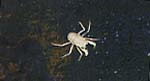 Mulu�s
caves contain an unusual array of flora and fauna too. Here are three
species of swiftlet, 12 species of bat and nine species of fish, including
the cave flying fish and blind catfish, cave scorpions (which are
poisonous but not deadly) are not uncommon. Other subterranean species
include albino crabs, huntsman spiders, cave crickets, centipedes and
snakes (which dine on swiftlets and bats) these creatures have been
described as living fossils - isolated survivors of ancient groups,
long since disappeared from South East Asia. Mulu�s
caves contain an unusual array of flora and fauna too. Here are three
species of swiftlet, 12 species of bat and nine species of fish, including
the cave flying fish and blind catfish, cave scorpions (which are
poisonous but not deadly) are not uncommon. Other subterranean species
include albino crabs, huntsman spiders, cave crickets, centipedes and
snakes (which dine on swiftlets and bats) these creatures have been
described as living fossils - isolated survivors of ancient groups,
long since disappeared from South East Asia.
Mulu Caves Fast Facts
The Sarawak Chamber - 600 metres long, 450 metres wide, and 100
metres high is the largest natural chamber in the world: big enough to fit
in eight Boeing 747 airplanes lined up nose to tail!
Clearwater Cave - over 50 km long, is the longest cave system in
South East Asia.
Deer Cave - has the distinction of having the largest cave entrance
in the world atone kilometre wide and 120m high, is said to be the world�s
largest cave passage. It can accommodate London�s St Paul Cathedral five
times over
Clearwater Cave & Wind Cave
There are two ways of reaching Clearwater. Firstly, you can trek along a 4
km nature trail which takes approximately one and half hours. The normal
tour however is by longboat along the Melinau River, stopping off at Wind
Cave (which is part of the Clearwater Cave system) along the way. It
normally takes about 15 minutes to reach Wind Cave by boat.
 A
plankwalk leads from the riverbank to the entrance of Wind Cave. As its
name suggested, Wind Cave was breezy and at certain spots, the wind was
rather strong. At the end of the passage is the famous King�s Chamber,
brilliantly lighted up to highlight the stalactites and stalagmites. The
400-metre plankwalk that leads to Clearwater Cave is built hanging on the
limestone cliff that had fallen down vertically to the floor of Sungai
Melinau. A
plankwalk leads from the riverbank to the entrance of Wind Cave. As its
name suggested, Wind Cave was breezy and at certain spots, the wind was
rather strong. At the end of the passage is the famous King�s Chamber,
brilliantly lighted up to highlight the stalactites and stalagmites. The
400-metre plankwalk that leads to Clearwater Cave is built hanging on the
limestone cliff that had fallen down vertically to the floor of Sungai
Melinau.
The path takes you to a shallow tributary that ends with a deep
pool
at the foot of a hill.
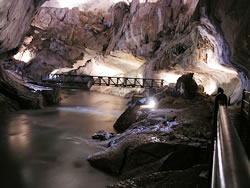 From
here you will climb a flight of 200 steps through the forest to the mouth
of Clearwater Cave. With its underground river, The gushing sound of its
underground river could be heard in the cave. At the end of the passage
you will climb down the steps to the picnic area. At the base of the steps
there is a crystal clear pool that is filled by water that flows out of
the cave. Here visitors can take a refreshing dip in its cold water if
they wish to do so. Locals believe that a dip in Clearwater River will
restore one�s youth by five years! From
here you will climb a flight of 200 steps through the forest to the mouth
of Clearwater Cave. With its underground river, The gushing sound of its
underground river could be heard in the cave. At the end of the passage
you will climb down the steps to the picnic area. At the base of the steps
there is a crystal clear pool that is filled by water that flows out of
the cave. Here visitors can take a refreshing dip in its cold water if
they wish to do so. Locals believe that a dip in Clearwater River will
restore one�s youth by five years!
Deer Cave & Lang's Cave
Deer Cave is reached by following a three kilometre plankwalk There is
much to see on the way to the cave, including some superb rainforest,
jungle streams and an ancient Penan burial cave. Deer Cave is simply huge
- it is just over 2 kilometres in length and never less than 90 metres
high and wide. The main chamber, which is partially lit by sunlight, is
174 metres wide and 122 metres high. This is the area where deer used to
shelter so the local Penan and Berawan people named the cave Gua Payau or
Gua Rusa (Deer Cave).
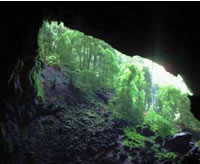 A
winding path leads into the cave following the natural contours of the
cave floor. The Deer Cave was home to a huge bat colony and guano covers
the cave floor thickly - the stench can be quite overwhelming. A
winding path leads into the cave following the natural contours of the
cave floor. The Deer Cave was home to a huge bat colony and guano covers
the cave floor thickly - the stench can be quite overwhelming.
Sights to watch out for here are the famous rock formation resembling the
sharp profile of former US president Abraham Lincoln and the beautiful
green Garden of Eden at the other entrance
Lang Cave was a short walk from Deer Cave. This small cave has intricate
carvings and formations like works of art. With bright spotlights placed
at strategic spots, the low-ceilinged cavern is turned into a unique
gallery showing off beautiful exhibits at all angles.
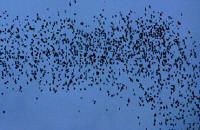 Between
5 and 7 pm, if the weather is fine, visitors are treated to the
spectacular sight of black clouds of millions of free-tailed bats emerging
from the entrance of the cave in their daily flight ritual in search of
food. The bats, mostly measuring 15cm from one wing tip to the other, fly
out of the Deer Cave in spiral-like formations, like ribbons intertwined
in the air. The exodus takes one hour! Between
5 and 7 pm, if the weather is fine, visitors are treated to the
spectacular sight of black clouds of millions of free-tailed bats emerging
from the entrance of the cave in their daily flight ritual in search of
food. The bats, mostly measuring 15cm from one wing tip to the other, fly
out of the Deer Cave in spiral-like formations, like ribbons intertwined
in the air. The exodus takes one hour!
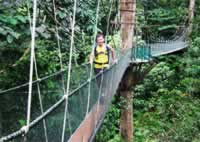 Canopy Skywalk Canopy Skywalk
Midway along the three km plankwalk to Deer Cave is Gunung Mulu National
Park�s �latest� attractions � the Canopy Skywalk. It is the world�s
longest tree-based canopy walk at 480 metres long. Suspended between 15
trees and standing about 30 metres (as high as an eight-storey building)
above the forest floor, the skywalk forms a circular route to a separate
exit tower.
The best time to enjoy the canopy walk was during the fruiting season when
tree-top residents like monkeys, birds and insects would be out enjoying
the fruit.
For cavers wishing to explore caves not open to public, there are
designated adventure caves within an hour of park HQ. Experienced guides
can be organised. The most accessible adventure cave is about an hour�s
trek following the river course through the Clearwater caves. Cavers
should bring their own equipment.
Note
No visitors are permitted to travel in the park without an
authorised guide.
Entry Fees � RM 20 per adult and RM 5 per child /
camera RM 5 / video RM 10, professional filming RM 200
Equipment � there is a small store at the park HQ that sells basic
necessities and another shop just outside the park boundary at Long Pala.
A sleeping bag is essential fir Gunung Mulu trips, others include insect
repellent, wet weather gear and a powerful torch.
Best time to go � it is best to avoid visiting the park during the school
and public holidays. In December the park is closed to locals but remains
open to tourists.
 Mulu
National Park Mulu
National Park
|
|

