|
The best way to experience
adventure to appreciate the amazing variety of life in Mulu National Park
is to go on jungle and mountain treks that require overnight stays at
jungle camps. Whether you travel through the park on foot or by longboat
you will interact with the local people, Ibans, Berawan, or the still
nomadic Penans who live off the jungle.
Mulu has three adventure treks, all of which require a certain level of
physical fitness and must be accompanied by official park guides. Trek
arrangements and necessary equipment and food can be made with us.

If you feel really fit you can go on to the summit of Gunung Mulu, the
toughest trek in the park, or to view the popular Pinnacles on Gunung Api.
You can also do the Headhunter's Trail trek that combines upriver travel,
jungle trekking and experience an overnight stay at an Iban longhouse
Gunung Mulu
The trek to the summit of Gunung Mulu (2, 376 m - Sarawak's second highest
mountain) has always attracted adventurers, and trekkers will certainly be
following in the footsteps of the famous. The first attempt on Gunung Mulu
was made by Spencer St. John, the British consul in Brunei in 1856. His
efforts were thwarted by �limestone cliffs, dense jungle and sharp
pinnacles of rock�. A similar effort by , resident of Marudi. Dr. Charles
Hose, who led a 25 day expedition in 1893, also ended in failure with his
path blocked by 600m high cliffs. It will be another 50 years before a
successful attempt was to be made.
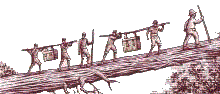 Indeed,
the first person to find a way to the top of Mulu was not a mountaineer or
explorer; but a Berawan rhino hunter named Tama Nilong. In the 1920's,
whilst following rhino tracks he discovered the 'south-west ridge' and a
way to the summit. In 1932, it was this rhino hunter Tama Nilong, who
successfully guided Edward Shakelton�s Oxford University Expedition to the
summit. What is interesting is that one of the oxford undergraduates on
that expedition was Tom Harrison, who later made the
Niah archaeological
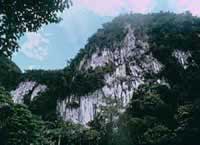
discovery. The cliffs of the Melinau Gorge rise a sheer 600m, and are the
highest limestone rock faces between Thailand and Papua New Guinea. Indeed,
the first person to find a way to the top of Mulu was not a mountaineer or
explorer; but a Berawan rhino hunter named Tama Nilong. In the 1920's,
whilst following rhino tracks he discovered the 'south-west ridge' and a
way to the summit. In 1932, it was this rhino hunter Tama Nilong, who
successfully guided Edward Shakelton�s Oxford University Expedition to the
summit. What is interesting is that one of the oxford undergraduates on
that expedition was Tom Harrison, who later made the
Niah archaeological
discovery. The cliffs of the Melinau Gorge rise a sheer 600m, and are the
highest limestone rock faces between Thailand and Papua New Guinea.
 Gunung
Mulu Climb Gunung
Mulu Climb
The minimum time to allow for the climb is four days, three night; tents
are not required if you stay at camps 1 and 2. the main summit route
starts from the plank-walk at park HQ heading towards Deer Cave. The Mulu
walkway forks left after about 1 km. From the headquarters it is an easy
four to five hour trek to camp 1 at 150m, where there is a shelter. The
second day is a long uphill slog 98 � 10 hours to camp 4 (1,800m) where
there is also a shelter. Past camp 3, the trail climbs steeply to Bukit
Tamau, which affords good views of the park. There are many pitcher plants
along this stretch. From camp 4 (known as the summit camp), the path
passes the helicopter pad, from which there are magnificent views of
Gunung Benarat, the Melinau gorge and Gunung Api. The final trail to the
summit is steep; there are fixed ropes. Around the summit area, the
pitcher plants is common. From camp 4, it takes 11/2 hours to reach the
summit and a further seven hours back down the mountain to camp 1
Note
Camp 1 has water, as does camp 4, if it has been raining. Water should be
boiled before drinking. It is necessary to bring your own food; in the
rainy season it is wise to bring a gas cooking stove. A sleeping bag and
waterproofs are also necessary and spare clothes wrapped in plastic bags
are a good idea.
 The
Pinnacles The
Pinnacles
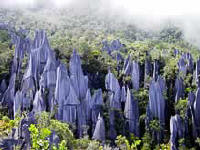
The famous Pinnacles at Mulu consist of a series of 45 metre high razor
sharp limestone spikes soar that tower above the surrounding jungle -
these are the Pinnacles, a distinctive geological feature half way up face
Mulu's Gunung Api. The Pinnacles can be reached by a three-day trek
(though it is possible to do it In 2 Days) from Mulu National Park HQ in
what can be described as a very challenging trek, where coming down is
just as hard as the ascent.
The Pinnacles Trek
It takes two to three hours boat ride, depending on the river level from
Park HQ to Kuala Berar. It is then a two to three hour trek (8km),
following flat jungle terrain, to camp 5. Visitors here are advised to
plan their itinerary carefully as it is necessary to calculate how much
food would be required. Camp 5 is situated next to the Melinau river, near
the Melinau Gorge, which separates Gunung Benarat from Gunung Api. There
is hostel-style accommodation at the camp, and cooking facilities. From
the camp it is possible to trek up the gorge as well as to the pinnacles
on Gunung Api.
 The
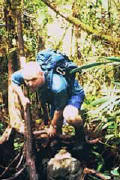
real hike begins the following morning. The trail is 2.4 km in length but
rises some 1,200 metres from Camp 5 to the viewpoint, passing through
lowland dipterocarp forest before climbing steeply through moss forest.
Here the trees area a lot smaller and everything is covered in slippery
green moss. Limestone debris also litters the trail so trekkers must
proceed with care. The last section of the trail is nearly vertical. The
final leg, through mist and across moss-covered rock is almost vertical
using ladder, ropes and wooden pegs to climb. You will come out onto a
rocky outcrop that provides a stunning view of pinnacles. After taking
some photos and a short rest you will begin the descent back to camp 5 and
the second overnight stay before returning back to Park HQ. The
real hike begins the following morning. The trail is 2.4 km in length but
rises some 1,200 metres from Camp 5 to the viewpoint, passing through
lowland dipterocarp forest before climbing steeply through moss forest.
Here the trees area a lot smaller and everything is covered in slippery
green moss. Limestone debris also litters the trail so trekkers must
proceed with care. The last section of the trail is nearly vertical. The
final leg, through mist and across moss-covered rock is almost vertical
using ladder, ropes and wooden pegs to climb. You will come out onto a
rocky outcrop that provides a stunning view of pinnacles. After taking
some photos and a short rest you will begin the descent back to camp 5 and
the second overnight stay before returning back to Park HQ.
Note
It is advisable to hire a longboat for the duration of your trip at and
around camp 5. the boats has to be abandoned at Kuala Berar at the
confluence of the Melinau and Berar river. Though it is only used for the
first and last part of the trip, for safety it could prove crucial in the
event of an emergency. There are no trails heading back to the Park HQ and
there has been cases of fever stricken people stuck in the jungle.
Headhunters' Trail
The Headhunter's Trail is a great way of entering or leaving
Gunung Mulu National Park. The trek combines upriver travel, jungle
trekking and an overnight stay at an Iban longhouse.

The trail used in bygone days by local tribesmen moving from one river
valley to another on headhunting raids, follows the route taken by Kayan
headhunting parties who paddled up the Melinau River to the Melinau Gorge.
They then dragged their war canoes through the forest for 3 km until they
reached the banks of the Terikan River, where they launched headhunting
raids against the people of the Limbang area. Rest assured, head hunting
definitely has not been practiced in Sarawak for many, many years. But
practiced it was in days gone by, as skulls hanging from the rafters of
several longhouses will bear witness. Taking a head was a sign of manhood.
One reason it became so popular was that no self-respecting maiden would
consider a young man who had not taken a head.
 The
Trek The
Trek
The basic trail route, is a boat ride from Park HQ to Kuala Berar and
followed by a 2-3 hours trek to Camp 5. From Camp 5 it takes another 4-5
hour trek following the 11.3 km trail to Kuala Terikan. Here you can
either spend the night in the accommodation units at the ranger station at
Ng. Mentawai (about 15 minutes from Kuala Terikan), or travel on by
longboat for 3-4 hours (depending on boat engine and water level) to reach
the longhouse (Rumah Bala Lesong). After A few glasses of tuak (rice wine)
in a longhouse and you might get the older men relating tales of the
grisly exploits of their not-too-distant ancestors.
After an overnight stay the journey continues by boat downriver to Nanga
Medamit. From there it is possible to travel by road to Limbang.
The Headhunter's Trail can also be done in reverse, starting from Limbang
and ending up at the park HQ. Either way the trek offers an excellent
introduction to the rivers and rainforest of Mulu and the added attraction
of a longhouse visit. As the trek includes an overnight stay at Camp 5, it
can also offers the option of climbing the Pinnacles as part of their
Headhunter's Trail Trek package.
 Mulu
National Park Mulu
National Park |
|

