|
Kuala Selangor Nature Park
The Kuala Selangor Nature Park covers about 800 acres of secondary scrub,
wetlands, inter-tidal mudflats and mangrove swamps. It is a world-renowned
bird sanctuary, with about 160 species recorded here. Run by the Malaysian
Nature Society, it features hides, paths, watchtowers and boardwalks with
facilities for lectures and accommodation as well.
Bukit Melawati
This landscaped hill offers a panoramic view of the Selangor coast and the
Klang Valley. Being the former capital and site of the first Selangor
Sultanate�s palace, there are several fascinating historical attractions
to visit. Located about an hour�s drive from Kuala Lumpur It is an ideal
spot for a day out with the family.
On weekdays, it is possible to drive along the network of small roads on
the hill, but on weekends, the roads are closed to vehicles. There is
however a tram for those wanting a quick tour and tickets are available at
the base of the hill. The best way to take in the sights however, is still
by walking up.
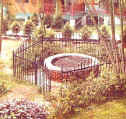 Follow
up the path from the parking area and up the steep but short staircase.
One of the first thing to see along this path is the �Poisoned Well�. The
well was was used to execute traitors. Filled with a poisonous mixture of
latex and juice from the bamboo shoots, these unfortunates, met their doom
by being slowly lowered in this well. Follow
up the path from the parking area and up the steep but short staircase.
One of the first thing to see along this path is the �Poisoned Well�. The
well was was used to execute traitors. Filled with a poisonous mixture of
latex and juice from the bamboo shoots, these unfortunates, met their doom
by being slowly lowered in this well.

.
Perched on its summit, the Altingsburg Lighthouse is still in working
condition. Unfortunately the lighthouse is out of bounds to the public.
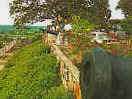 Beside
the lighthouse are the remains of the first fort called Fort (Kota)
Melawati. Though only a couple of these remnants of the past remain, their
location offers a commanding view of both the sea and land. An outer wall
with three original cannons still look out to the sea. Beside
the lighthouse are the remains of the first fort called Fort (Kota)
Melawati. Though only a couple of these remnants of the past remain, their
location offers a commanding view of both the sea and land. An outer wall
with three original cannons still look out to the sea.
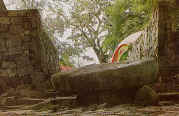 Part
of the fort�s original gates are still intact, as is the courtyard with
the executioner's stone block. Known as �Batu Hampar�, it was used to
behead criminals. Legend has it that one of the girls residing in the fort
was caught committing adultery and executed at the stone. Her blood was
then sprinkled around the fort. The reason why is not known. Part
of the fort�s original gates are still intact, as is the courtyard with
the executioner's stone block. Known as �Batu Hampar�, it was used to
behead criminals. Legend has it that one of the girls residing in the fort
was caught committing adultery and executed at the stone. Her blood was
then sprinkled around the fort. The reason why is not known.
Leading up to the courtyard are the remains of the legendary �Hundred
Steps�, named so because of the number of terraces leading down to the
Batu Buruk docks. In the old days , travellers and merchants had to pass
these steps before heading towards the markets in Kuala Selangor.

Shaded by ancient rain trees, there are benches and gazebos all over the
hill that make great spots for picnics. However picnickers have to be wary
of the monkeys there. Two species of have made the hill their home. The
�Silver-Leaf� monkeys are the shy ones, more reticent than the �Kera�,
which grabs not just food, but would snatch bags and cameras off
unsuspecting hands.
Other than the Kuala Selangor museum which is also on the hill, visitors
will, on their way down, come across the Royal Mausoleum. Here lay the
remains of the first three Sultans of Selangor. A �penggawa� or �chief
cannon�, ceremonially draped in yellow cloth, sits in the mausoleum. This
cannon was discovered in 1966 in the Buluh River, some 19km from Kuala
Selangor. Research showed that it was originally known as Petai Boga or
�white princess�.

Getting There
Driving is most convenient, either use the Sungai Buluh trunk road or the
road from Klang. When returning be sure to watch out for road signs as the
turn-off back to Sungai Buluh and K. Lumpur is quite small and can be
easily missed. Bus services to Kuala Selangor are available from the Klang
Bus Terminal.
|
|

