|
� History � People & Culture � Economy � Shop
& Dine � Getting There �
History
Perlis is closely related with and originally was a part of neighbouring
state of Kedah. After the Siamese conquered Kedah in 1821, the British, with
the intention of securing their interests in nearby Perak, negotiated the
1826 Burney and Low Treaties which resulted in formal relations being
established with the Malay states of Kedah and Perak with the kingdom of
Siam, their nominal overlord.
However,
the exiled Kedah Sultan, Ahmad Tajuddin, was not returned to his throne.
Sultan Ahmad and his armed supporters then fought on for his restoration for
over twelve years (1830-1842). In 1842, the exiled Sultan finally agreed to
accept Siamese terms, and was restored to his throne of Kedah.

However, the Siamese separated Perlis and made it into a separate
principality and a vassal to Bangkok. Syed Hussain Jamalulail, of Arab
descent and grandson of the Sultan of Kedah, became the first Raja of
Perlis. His descendants still rule Perlis, but as Rajas, instead of as
Sultans.
With the signing of the Bangkok Agreement between the British and Siamese on
9 July 1909, as with Kedah, the British took control of Perlis.
The first British Resident or advisor to Perlis was Meadow Frost. With the
Japanese invasion in 1941, Perlis was returned to Siam by the Japanese as a
reward for Siam's
alliance with Japan. This brief annexation ended with the Japanese
surrender. After World War II, Perlis returned to British rule until it
became part of the Malayan Union, and the Federation of Malaysia in 1957.
Since 2000, the Raja or hereditary monarch has been Tuanku Syed Sirajuddin.
People & Culture
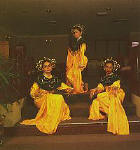
There is a predominance of Malay and Thai influence here. The people of
Perlis indulge in traditional games, dances and other interesting
"hand-me-downs" entertainment. This is evident in its colourful music and
dance performances such as the Tarian Canggung (a traditional post harvest
celebration dance) and the Tarian Terinai (traditional dance for royal
ceremonies).
Economy
Generally, the economy in Perlis is made up of agriculture, fishing and the
forest industry. Perlis is also home to the largest sugar cane plantations
in the country. Asides from sugar cane, rubber is also extensively
cultivated while mango and watermelon are the state's main form of fruit
produce. Although still not highly active in it, the state has slowly moved
towards development and on medium-scale industrial and manufacturing
activities
Local Cuisine
n Perlis, a visitor can choose to eat at either luxurious fine dining spots,
air-conditioned restaurants or go casual by dining al fresco at the hawker
centers. You will be pleased to know that prices are kept to a reasonable
rate whilst service is
both efficient and courteous.
 Perlis is probably the state that serves the best tom yam in the country,
thanks to its neighboring relations to Thailand. Besides Thai dishes, you
must also try the exotic traditional Malay fare, Chinese cuisine and Indian
meal. Perlis is probably the state that serves the best tom yam in the country,
thanks to its neighboring relations to Thailand. Besides Thai dishes, you
must also try the exotic traditional Malay fare, Chinese cuisine and Indian
meal.
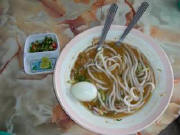
�Laksa Perlis� is a homemade thick, rich, spicy, and creamy fish gravy
seafood noodle, its ingredients can be combined according to you preference.
Kuala Perlis is also known for its mouth-watering and easily available
seafood. Not only is seafood fresh, but it is also relatively cheaper than
in other parts of the country.
Shopping
Padang Besar and Bukit Kayu Hitam, the border towns are best for economical
buys. Padang Besar is always alive with shoppers as many varieties of goods
especially popular products leather goods, garments and household items.
These are cheaply manufactured in Thailand and sold in town. Beyond the rail
tracks is Pekan Siam - a bargain hunters' paradise. Besides agricultural
goods, duty free shopping is also available in Padang Besar. The town is
filled with all shades and designs of textiles, footwear, handicrafts,
decorative items, foodstuff, souvenirs, fruits and much more.
As for Handicrafts, visit the Perlis Craft Cultural Complex.
Basket weaving is worth checking out here. Look for the mengkuang (screwpine)
and pandan (pandunas) leaves that are woven into baskets, mats and the
quirky, conical tudung saji (food covers).
Getting There
The main entry points to Perlis are usually Padang Besar and Bukit Kayu
Hitam, which is near the Thai border in the north. Alternatively, you can
get to Kuala Lumpur first and then make your way to the state. If not, you
may go for another option, which includes taking a trip to Penang Island or
Langkawi first, then hopping on to Perlis.
By Road
The north-south expressway has made it easy for any traveler to drive
up to and roads are accessible from major towns and cities in the Peninsula.
From major towns, air-conditioned express buses are also available to Kangar
and also to Kuala Perlis.
By Air
If you are traveling to the country by air, please take note that there are
no direct flights to Perlis. Don't forget, the state is really very small.
However, if you insist on flying, the nearest stop is at Alor Setar, Kedah,
whereby you can take a cab to the capital of Perlis, which is Kangar. The
ride will take you about 45 minutes.

|
|