|
� Kota Lukut (Lukut Fort) � Lukut Museum
� Sri Menanti Palace (Royal Museum) � Tampin Museum � Pengkalan Kempas
Historical Complex �
Kota Lukut
Kota (fort) Lukut remains as one of the best-preserved Bugis forts in
the country. Built in 1847 by Raja Jumaat bin Raja Jaafar to protect the
valuable tin trade. Built on Bukit Gajah Mati (Dead Elephant Hill) It is
a perfect example of a defense system used during the 19th century.

The fort was a vantage point where the Raja used as a base to oversee
his thriving tin business and community. The fort is 607 feet long by
505 feet wide and had a ditch of 15 feet, which was defended by large
muzzle loading guns with a clear view of the Lukut river valley ad was
able to defend all sides of the square fort. The moat that surrounded
the fortress was booby trapped with pointed bamboo sticks. Apart from
that, Raja Jaafar also built a large two-storey house in the centre of
the fort and raised a body of 22 Malay Uniformed Police to protect the
fort.
Apart from the remains of rhe old fort are also the remains f a
two-storey building in the middle and the royal well. The royal
household however took their water from the royal well, which was
watched over all hours by guards.
Raja Jumaat gained immense admiration and respect from his people and
the neighboring rulers. He also gained total control of the local tin
trade making him one of the more successful rulers.
The fort was further enlarged and fortified during the reign of Raja Bot,
Raja Jumaat's son. Security was further tightened with the employment of
30 Arabian soldiers. It was said the Raja Bot faced tremendous
opposition from Raja Sulaiman of Sungai Raya, who had refused accede his
powers. Political instability and violent disturbances eventually eroded
the powers of the rulers, and with it, the prominence of the Lukut Fort.
Location: 30km,
south-easterly from Seremban.
From the North-South Expressway, exit at Port Dickson (Seremban)
Interchange and proceed to Port Dickson through the Port Dickson
highway. Lukut is only a few kilometres away from Port Dickson town.
Lukut Museum
At the bottom of the hill sits the Lukut Museum. Displays on the
recovery of the sunk Dutch warships just off Cape Rachado gives a good
idea of the historical significance of the area during the 16th and 17th
century. Other displays show the culture, economy and history of the
Minangkabau clan in Negri Sembilan.
Open - Tues to Thurs: 9am to 5 pm
/ Fridays:-9 am to 12 noon & 3 pm to 5 pm. Admission is free.
Sri Menanti Palace (Royal Museum)
The Sri Menanti palace was rebuilt to replace the former as it was burnt
down by the British in 1875, during the civil war between Yam Tuan Antah
and the British. This was replaced with the Istana of Sri Menanti, one
of the few last remaining timber palaces in Malaysia. It was designed by
two Malay carpenters; Tukang Kahar and Tukang Taib, and with the
assistance of Mr. Woodford who was the head draughtsman at the Public
Works Department. Completed in 1905 and occupied from Between 1908 and
1931 by uanku Muhammad Shah, the 7th Ruler or Yang Di-Pertuan Besar of
Negri Sembilan.
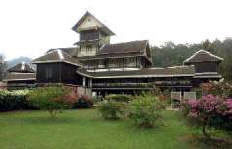 The
four-storey palace Minangkabau "Rumah-rumah Adat" architecture, was
constructed without nails, pieced together with hardwood dowels and
rivets. 99 posts were used in the construction and the entire structure
was raised on timber posts made of penak (cengal) wood, transported 64km
from a forest in Bukit Perigi, Jelebu. Each post represents famous
warriors from various groups. The four main posts at the centre of the
palace rise 20 metres(60feet) from the ground to the central tower (the
highest floor) and each post is made from a single cengal tree trunk.
Decorating the roof of the central tower are a pair of locked buffalo
horns, regarded as a protective symbol for Minangkabau houses. The roof
tiles or genting, are made from ironwood (kayu belian), a hardwood
species that is extremely rare now. These were imported from Sarawak.
Istana Sri Menanti was the official residence of the royal family until
1931 and was turned into The
four-storey palace Minangkabau "Rumah-rumah Adat" architecture, was
constructed without nails, pieced together with hardwood dowels and
rivets. 99 posts were used in the construction and the entire structure
was raised on timber posts made of penak (cengal) wood, transported 64km
from a forest in Bukit Perigi, Jelebu. Each post represents famous
warriors from various groups. The four main posts at the centre of the
palace rise 20 metres(60feet) from the ground to the central tower (the
highest floor) and each post is made from a single cengal tree trunk.
Decorating the roof of the central tower are a pair of locked buffalo
horns, regarded as a protective symbol for Minangkabau houses. The roof
tiles or genting, are made from ironwood (kayu belian), a hardwood
species that is extremely rare now. These were imported from Sarawak.
Istana Sri Menanti was the official residence of the royal family until
1931 and was turned into
a Royal Museum in 1992.
Location: The turn off to Sri
Menanti is about 13km from Kuala Pilah town.
Signs to Sri Menanti are clearly marked. Once on this road, just head
straight in.
The old Palace is situated at the end of the village.
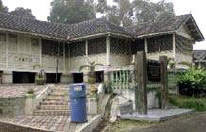 Tampin
Museum Tampin
Museum
Situated on a hilly area close to the Tampin Recreational Park,
surrounded by overhanging trees and shrubs, this single-storey museum
building, built in the 1920's was originally the residence of a high
ranking government officer. It was the first district museum to be
developed in Negeri Sembilan. The exhibition areas display various
socio-cultural artefacts such as musical instruments, traditional Malay
weapons and some regalia signifying the traditional and cultural
practices of the Malay community including the traditional attire of
dignitaries such as the Tunku Besar Tampin. Aside from the usual items
connected with the history and development of the state, the museum also
has some unusual and informative items on display such as agricultural
tools from days of old.
Open: Tuesday � Sunday: 10am �
4pm Closed on Monday
Location: Jalan Bukit Tampin, Tampin
Pengkalan Kempas Historical Complex
Pengkalan Kempas is a vet small town that is normally easily bypassed
except for those historical buffs and those fascinated by mysterious
artifacts. A short distance away on an oil palm plantation, lies a
little known place called the Pengkalan Kempas Historical Complex. The
complex is famous for two things � the mausoleum of Sheikh Ahmad Majnun
(the archrival of Sultan Mansur Shah who was the Sultan of Malacca from
1457�1477), and the megaliths.
A 1.2m pillar in front of the grave relates the story of the Sheikh
Ahmad Majnum, a Islamic missionary and a holy man who came to Melaka in
the 14th century, who was murdered by Tun Barah Kelang (believed to be
Tun Perak) in 1467. He was probably killed after a quarrel with Sultan
Mansur of Melaka and his followers erected the memorial, which is now
also known as Keramat Sungai Udang Syeikh Ahmad Majnun.
His grave is reported to be the oldest known Muslim grave in Malaysia.
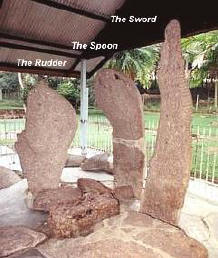 Adjacent
to the grave are three granite monoliths. There are part of a number of
megalithic stones strewn around the area. Some fully carved and others
left unfinished. Adjacent
to the grave are three granite monoliths. There are part of a number of
megalithic stones strewn around the area. Some fully carved and others
left unfinished.
These three strangely shaped stones were named - Batu Kemudi (the
'rudder'), Sudu (the 'spoon') and Pedang (the 'sword') after their
shapes by the locals attributing to their shapes and are believed to be
carved during the 2nd or 3rd century. Some of them have Arab and
Sumatran scripts carved onto them but there is no evidence that the
inscriptions were chiselled onto the stones later.
 These
megaliths are mysterious partly for their shape and also for the legends
behind them. These ancient stones are revered by some local inhabitants
as having special powers. The local myths say these large carved stones
actually grow at night, earning them the nickname Batu Hidup (the Living
Stone). These
megaliths are mysterious partly for their shape and also for the legends
behind them. These ancient stones are revered by some local inhabitants
as having special powers. The local myths say these large carved stones
actually grow at night, earning them the nickname Batu Hidup (the Living
Stone).
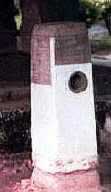
A headstone-like structure with a hole in the middle is believed to have
been an ancient form of 'lie-detector'. The accused would put his arm
through the hole and each time false answers to questions were given,
the hole would constrict, tightening round the arm until the truth was
told!
Location: 35km away from Port
Dickson town.
|
|