|
� Pulau Besar � Pulau Upeh �
Pulau
Besar
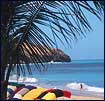
Noted for its sandy beaches, blue waters, sun and
chalets on stilts. It is an excellent resort for swimming, fishing and
snorkeling. The 133-acre Pulau Besar is the biggest of 8 islands off the
coast of Melaka.

The island is said to be the cradle of the
earliest civilisation on Peninsular Malaysia and is rich in legends of the
mermaid and the prince, as well as holy graveyards and temples.
Pulau Besar here is the island that lies 3 nautical miles off the coast of
Malacca and not be confused with the Pulau Besar of Johor. While they may
share the same name, they are entirely different islands.
Used as a base by the Japanese as a base during WW II, the legacy of it's
history is evidenced by several ancient graves, a few wells in the jungle
, a dynamite store and a bunker. Due to the island's compact size most of
the attractions can be visited in a day.
There is a mystical touch to the island. Many early missionaries from the
Middle-East were buried here. What is so special about the graves is that
they are seven feet long and are believed to be �keramat� (tomb of Islamic
saints), so many people come here to offer prayers and to seek blessings.
It also has become a sort of pilgrimage to a large number of Indian
Muslims in Malaysia. Much of this pilgrims come to Pulau Besar to visit
what is believed to be a mausoleum of a Wali. There also exists a cave
which is said to be the place of meditation for another Wali named Yusof.
Near this cave, it is claimed one can see the footprint of the Wali on a
boulder.
There are many wells on the island, the most famous of which is a �wishing
well� known as Tempayan, believed to have been dug long ago by islanders
to hide their valuables from pirates seeking refuge during the monsoon. It
is said that the kind-hearted will find valuables when they dip their
hands into the shallow well.
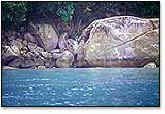 Yunus
Cave, accessible only during the low tide, was a favourite meditation
spot for early spiritualists. It is believed that in ancient times,
warriors came to the cave to learn the art of mysticism. It was also used
for the training of the art of 'silat', a form of martial arts. Yunus
Cave, accessible only during the low tide, was a favourite meditation
spot for early spiritualists. It is believed that in ancient times,
warriors came to the cave to learn the art of mysticism. It was also used
for the training of the art of 'silat', a form of martial arts.

More difficult to locate are the the Well of Spirits and two famous
boulders called Sailing Boulder and Split Boulder. To get to the famous
Batu Belah or Split Rock you have to go through a jungle trek and climb a
hill. When looking at the rock, you should bear in mind the story behind
it. It tells the tale of a young apprentice who did not obey the teachings
of his master who told him never to misuse his power. He choose not to
heed this advice. Before he could repent, his master took out his sword
and sliced the rock he was sitting on. The apprentice was to fall between
the cracks, after which the rock was to mysteriously rejoin, trapping the
apprentice forever.
Legends
Pulau Besar looks like a pregnant lady lying on her back. Thus, giving
rise to many folklore about it. The locals around Pulau Besar revere the
island and attribute it to many legends.
The most famous of these has it that several hundred years ago, a
beautiful and kind-hearted princess of the Sultanate of Malacca fell in
love with a fisherman from Sumatra. When the fisherman had to return to
Sumatra, he promised the princess that he would return to marry her. A few
months later, misfortune was to befall the happy couple when the boat the
fisherman was on, capsized on its way to Malacca after being caught in a
raging storm. The young fisherman was to go down with the ship.
All this time, the princess had been waiting patiently for the fisherman's
return. She was soon to discover that she was pregnant. Hearing no news
and in total desperation, she threw herself into the sea. Legend has it
that her body miraculously floated to the site of her lover's capsized
ship and remained there. This is said to account for the shape of the
island of Pulau Besar.
Another legend is about the shrine of the seven princesses The seven
maidens were said to have been on their way to Pulau Besar from India in
order to deepen their mysticism. Alas, their ship was also to sink along
the way. The graves of the seven princesses were buried on the island and
can still be seen until today.
There are two resorts in the island, IMM Putera and IMM Puteri which are
accessible by boat from Anjung Batu Jetty and Umbai Jetty.
 Getting
There Getting
There
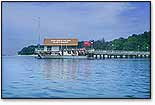
To reach the island, visitors can embark on air conditioned ferries from
Melaka Quayside. Another way is to take a bumboat or speedboat from Umbai
village, eight kilometres south of Melaka Town.
Location - 10km south of Melaka town and 3 nautical miles from Umbai
Pulau Upeh
This tiny island is also one of the most important Hawksbill nesting
sites in the country and is one of the few sites in the west coast that
has regular turtle sightings.

Located off the beaches of Tanjung Keling,
Pulau Upeh - also known as Das Pedra, or �place of stone�, by the early
Portuguese sailors, is only a 30 minutes ferry ride from the town's
jetty.
 Having
only one small sandy beach, here visitors get a chance to witness the
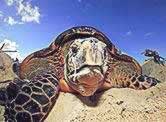
The critically endangered and beautiful Hawksbill turtle with its golden
brown, exquisitely patterned shell, nesting at the island beaches. Having
only one small sandy beach, here visitors get a chance to witness the
The critically endangered and beautiful Hawksbill turtle with its golden
brown, exquisitely patterned shell, nesting at the island beaches.
The egg-laying season is from March to June but visitors can expect
to sight a few turtles every night throughout the year.
Pulau Upeh has an interesting history behind it. Used as a lookout point
back in WWII, it was also believed to be a favourite port for pirates.
Quarrying activities were conducted here during the Portuguese
occupation era. Today, some of the historic sites like the British
Memorial Mast, an old well and World War II relics can still be seen on
the island. Also found here is an 80-ft tall observation tower from
where one can catch the magnificent view of sunset.
his island has become an ideal resting ground for one of the earth�s
rare species � the Hawksbill Turtle. This medium sized marine turtle
with a hawk-like beak and a thorny shell, brown and lightly striped
finds refuge here. The egg-laying season is from March to June but
visitors can expect to sight a few turtles every night throughout the
year.
To get to the islands, one can book a ferry ride from the Shahbandar
jetty, next the tourist information centre at Jalan Kota.
Threats
But the island of Pulau Upeh and its beach is now under immediate threat
from two directions. Last week its present owners, the Tenaga National
Electricity Company (TNB) which took over the island three years ago as
a possible training centre for its staff, making use of a disused hotel
and chalets left behind by a previous abortive development attempt,
announced that the island was for sale.
At the same time, developers working with the state government, are busy
reclaiming a second 400-acre slice of Malacca Bay, reaching within a
mile or so of the island. The effects of this on Malacca�s beaches,
including the narrow beach on Pulau Upeh, already the subject of
erosion, is unknown. No overall environmental impact study of this
reclamation work, or of other coastal infilling and development in
neighbouring Negri Sembilan State, on Malacca�s coast has been
undertaken � or if it has, it has not been made public.
|
|