|
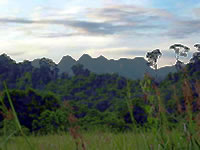
Known to be one of the world's most
bio-diverse forest, Lambir Hills is home to more than 1,000 species of
trees. There are plants and insects here that have not yet been discovered
as well as waterfalls and bathing pools for a quick dip
 The Park The Park
The Lambir Hills National Park is located along the Miri-Bintulu Road,
some 30km south of Miri Town. It covers an area of about 6,952 hectares
which consists of the central portion of the Lambir Hills, a rugged
east-west trending sandstone escarpment with a maximum height of 465
metres.
To the geologist this hilly area means alternating Miocene sandstone and
shale, and the presence of minor amounts of oil and gas, to the
biologist/ecologist, it means tropical lowland jungle wilderness harboring
some seventy-four species of ficus trees plus many wild, endangered animal
species. The nature lover feels the beauty of its seven waterfalls, and is
enticed by the genuine jungle atmosphere.
 Flora and Fauna Flora and Fauna
Apart from the various tree species, the park is very rich in order plant
species such as ferns, gingers, vines, palms, mushrooms, moss and lichen,
flowering and fruiting shrub trees, climbers and creepers. There are a
good variety of animals including bats, monkeys, pangolins and barking
deer. Up to 157 species of birds have been recorded. There are four
primary trails and seven secondary trails for visitors to explore the
forests, hills, valleys and waterfalls. They are well-marked no guide is
required and can be explored unguided. However, the Summit Trail which
leads to the Lambir's Summit, does require a guide and is excellent for
adventurous hikers.

Waterfalls
There are a series of small waterfalls along the Sg. Liam, about half a
kilometre from the Park HQ. Other accessible falls are the Pantu and
Nibong Waterfall along the Pantu Trail and the Pancur, Tengkorong and
Dinding Waterfall
along the Bakam Trail.
The Latak Waterfall is popular with visitors. it is about 25 metres high
and plunges sheer into a large deep pool with a broad sandy poolside. It
is a very pleasant spot for swimming, sunbathing and picnicking.
Accommodations
Stay ay the Park Headquarters consists of Type 5 Forest Lodges.
An interesting alternative is the new Borneo Tropical Rainforest Resort.
This agro and nature resort is situated adjacent to the park. 30 room and
18 chalet with a range of facilities for most budgets, includes
self-catering chalets
The Spirits of Lambir
There is also a deep magic version that is surrounded by legends.
According to many stories, Lambir is inhabited by semi-human beings called
Nagas � powerful spiritual entities revered throughout human history.
Every peak of the mountain range belongs to a (Naga) Cobra Queen. From
there she reigns over a hierarchy of jungle ghosts and ordinary animals.
In many ways these queens are the protectors of earth. They preside over
the jungle, and are said to be very close friends of the Buddha of
Compassion, a protector of all living beings. The Lambir Queens are
dwelling in the waterfalls and are invisible to the ordinary eye. Her
presence grants power, bliss and beauty. Yet there is a dark side, too. As
every human society has dark underworlds and mafias, so do the Nagas: some
spirits in inferior ranks require human sacrifices.
Such are the two mighty Nagas that dwell in the pond under the Latak
waterfall. One of the two is said to appear as a giant turtle, the other
one as a python snake. This water hole is some twenty-one feet deep, and
is alimented by an artesian spring that upwells fresh, cool water from
deep down the hill area. The water in the pond feels some seven degrees
cooler than the surface water rushing down from the stream above. Some
seven feet under the pond�s surface there is a magical cave that leads
into the mountain. Legend says those who can see the cave and enter will
receive immeasurable powers. Yet only a person of pure heart can enter the
cave. Hidden in a labirinth, guarded by cobras and dragons a orange onyx
sphere is posed on a dark rock - the wish-fulfilling gem. Only the Buddha
of Compassion can touch it.
In December 2004, park rangers hammered a sign into the ground saying:
�swimming not allowed.� The day before, a child had drowned, a male young
boy, the seventeenth victim recorded over some thirty years.
It was explained like this: roughly two times over a period of five years,
the Nagas of Latak require the sacrifice of human life. Choosing a child
�which has run out of luck and merit,� the victim disappears in the pond,
and is dragged down to the bottom by some awesome, invisible force � to
resurface later, lacking one eye, or one toe.
These ugly incidents don�t come without warning. The day before the
tragedy happens the rivers of Lambir are colored blood-red � a sign that a
sacrifice is imminent. All seventeen victims stem from Muslim, Chinese or
European families, whilst not a single victim is counted among the native
Iban, Kenya or Kayan tribes. But according to another legend, the juvenile
victims later reincarnate in the Lambir Hills to become Naga Queens.
The Seventh Naga Queen does not reside in Lambir, but lives on the
adjacent Bukit Song. She is described by the locals as particularly
strong, and of gentle nature. She began to dwell in Bukit Song after a
family conflict with her other queen sisters. Like human beings Naga
Queens do quarrel and fight from time to time. Unlike Bukit Lambir, the
Bukit Song jungles are not protected by National Park Law. Which meant it
became a logging concession some twenty years ago. In those days, a
Chinese logging company started to cut a grid of logging roads through the
virgin forest.
One day, a forest worker had a dream. The Queen of Bukit Song appeared in
great glamour and told the following message: �Please do not cut my trees
and kill my animals. I�ve sworn to protect them. You can drive through my
forest, but don�t cut into my forest. If you do so, many of you will die.�
The worker reported his dream, and many prayers and ceremonies were
performed in Chinese temples down in Miri town. But the rituals were
performed with unclean intentions, and prayers were poisoned by thoughts
of money and greed. As the logging continued � man�s greed (as always)
proved stronger than his fears- the following months were full of
spectacular bloody accidents. Many loggers died - being crushed by a tree,
squashed by a truck in reverse, or flattened by a collapsing pile of
timber. Then one day, the Queen appeared to the project manager in a
dream. She looked radiant and powerful, her upper half body a woman, her
lower parts a cobra. Her message was clear and to the point. She said:
�Stop killing my forest otherwise I�m going to wipe out your entire
family.�
This time the message was taken seriously. The logging stopped. And Bukit
Song has retained her virgin beauty to this very day.
May the wonders of this world withstand the onslaught of profiteering,
greed and the voracious appetite of an unconscious and ever-increasing
human population! May our children and grand-children witness the magic
beauty of world�s untamed wilderness!
|
|

