|
Niah National Park
Located on the Sungai (river)
Niah, the Niah National Park is about 3 km from the small town of Batu
Niah, a 110 km to the south-west of Miri in northern Sarawak. Though it is
one of Sarawak's smaller national parks, it is certainly one of the most
important as it is known as one of the birthplaces of civilisation in the
region.
 Spread
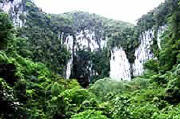
over 3,102 hectares, Niah National Park, consists of peat swamp,
dipterocarp forests, and gigantic limestone outcrops. Bird life in the
park is represented by bulbuls, tailor birds, trogons, crested wood
partridges, horn�bills, and eagle owls, Other inhabitants of the park
include Raja Brooke butterflies, flying lizards, and long tailed macaques.
Gunung Subis, 394 metres above sea level, dominates the landscape. Spread
over 3,102 hectares, Niah National Park, consists of peat swamp,
dipterocarp forests, and gigantic limestone outcrops. Bird life in the
park is represented by bulbuls, tailor birds, trogons, crested wood
partridges, horn�bills, and eagle owls, Other inhabitants of the park
include Raja Brooke butterflies, flying lizards, and long tailed macaques.
Gunung Subis, 394 metres above sea level, dominates the landscape.
The oldest modern human remains discovered in Southeast Asia were found at
Niah, making the park as one of the most important archaeological sites in
the world. Forty thousand years ago, the Niah Great Cave sheltered human
life. Excavations revealed plenty of human settlements in the area; tools,
cooking utensils and and ornaments, made of bone, stone or clay as well as
the discovery of a 40,000 years old human skull. The types of items found
suggested a long period of settlement reaching back into the palaeolithic
era (the earlist part of the stone age). What is most interesting about
Niah, is the continued human presence over tens of thousands of years and
sophistication of societies that gradually developed here.

A large burial site further into the mouth of the cave had clearly been
used from palaeolithic times right up to the modern era, as late as 1400
Ad. The earliest graves found in the deepest levels, were simple shallow
graves without adornment. Yet moving up through the layer, coffins and
urns appeared along with pottery, textiles and ornaments and even glass
and metal items, which came comparatively late to Borneo.
The famous Painted Cave is another highlight of the visit to Niah Cave.
Here, little human-like figures drawn in red haematite watch over a
gravesite where the bodies of the dead were each laid in its own
boat-shaped coffin.
 These
wall-paintings depicts the boat journey of the dead into the afterlife.
The meaning of the paintings was explained by the discovery of a number of
"deadth-ships" on the cave floor; Boat shaped coffins containing the
remains of the deceased along with items considered to be used in the
afterlife, such as pottery, ornaments and beads. The death-ships have been
dated as ranging between 1 AD and 780 AD, although local Penan folklore
tells of the use of dead-ship burials as late as the 19th century. These
wall-paintings depicts the boat journey of the dead into the afterlife.
The meaning of the paintings was explained by the discovery of a number of
"deadth-ships" on the cave floor; Boat shaped coffins containing the
remains of the deceased along with items considered to be used in the
afterlife, such as pottery, ornaments and beads. The death-ships have been
dated as ranging between 1 AD and 780 AD, although local Penan folklore
tells of the use of dead-ship burials as late as the 19th century.
The famous Niah Caves are located just a 30minute walk away from Park
Headquarters. A plank walk snakes through the caves, around fascinating
contorted rock formations. They consist of the Traders' Cave, Great Cave,
Burned Cave, Moon Cave, Painted Cave and several smaller caverns.

Today, local Penan tribesmen venture into the cave to collect edible birds
nests and the guano dropped by the myriad swiftlets and bats that live
there. After the squishy feel of guano beneath one's shoes and for some
fresh air, visitors may like a feel of the tropical jungle by following
two trials; namely, Jalan Bukit Kasut and Jalan Madu. The former leads up
to the summit of Bukit Kasut (Kasut Hill), offering a view of the forest
canopy below. Other forest trails take you up a 400 metre limestone ridge
or to an Iban longhouse.
A two-hour drive from Miri or Bintulu, the accommodation facilities at the
park consist of chalets units, a rest house and hostel-style rooms, all
with electricity and piped water., but unlike some of the other parks
there are no cooking facilities.
Similajau National Park
Situated about 30km from Bintulu Town, the
Similajau National Park with long sandy beaches, geological formations and
rainforest treks, offers a host of activities from trekking to bird
watching and coastal and river cruises
 It
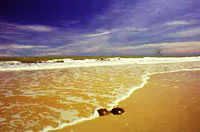
consists of a narrow shoreline dominated by many small inlets (crystal
clear fresh water streams, many cascading down from small waterfalls right
onto the beach sand) and unspoilt golden sandy beaches. The beach runs for
some 25km along the gently meandering coastline, punctuated by rocky
headlands. On weekends, it bursts to life as Bintulu folks come to enjoy a
short break. It
consists of a narrow shoreline dominated by many small inlets (crystal
clear fresh water streams, many cascading down from small waterfalls right
onto the beach sand) and unspoilt golden sandy beaches. The beach runs for
some 25km along the gently meandering coastline, punctuated by rocky
headlands. On weekends, it bursts to life as Bintulu folks come to enjoy a
short break.
 The
park boasts 24 Recorded species of mammals, such as gibbons, banded
langurs and long-tailed macaque. The Park records the presence of 185
species of birds, which include hornbills and migratory water birds like
Storm?s Stork. A very noteworthy reptile found here is the Saltwater
Crocodile. Lucky visitors may be able to sight dolphins out amongst the
waves. Turtle Beach is so named because turtles come there to lay eggs.
They leave behind tell-tale signs of track and depressions on the sand.
Visitors are advised that turtles are totally protected animals and that
it is an offence to disturb them or their eggs. The
park boasts 24 Recorded species of mammals, such as gibbons, banded
langurs and long-tailed macaque. The Park records the presence of 185
species of birds, which include hornbills and migratory water birds like
Storm?s Stork. A very noteworthy reptile found here is the Saltwater
Crocodile. Lucky visitors may be able to sight dolphins out amongst the
waves. Turtle Beach is so named because turtles come there to lay eggs.
They leave behind tell-tale signs of track and depressions on the sand.
Visitors are advised that turtles are totally protected animals and that
it is an offence to disturb them or their eggs.
Trekking allows you to see the changing scenes between two types of forest
here. In the dipterocarp forest, you see huge, majestic trees like meranti,
keruing and kapur dominating the landscape. In the heath forest, the scene
is strikingly different. Smaller trees dominate instead, like the selunsur
trees with reddish bark, insect-eating pitcher plants and wild orchids.
These can be found along the streams in the park. Guides will show you
where the huge estuarine or salt water crocodiles bask in the sun or where
green turtles come ashore to lay their eggs.
|
|

