|
� Lembah Bujang (Bujang
Valley) � Kota Kuah Kedah �
Bujang Valley
Lembah Buiang, lying between Gunung Jerai in the north
and Sungai Muda in the south, is regarded as Malaysia's richest
archaeological area

Lembah Bujang has a deep history that goes back 1,500 years . The rich
archaeological finds have at least sealed an important part of
Malaysia's history - the evidence that Malaysia and South East Asia had
already entered the international arena of economics and ergonomics a
long, long time ago
Bujang Valley stretches all the way from Gunung Jerai in the North to
Sungai Muda in the South. The area concentrated around the mouth of
Sungai (River) Muda has been of economic importance to Kedah since as
early as the 5th Century AD. By the 7th century, trade with the Indians,
Arabs and Chinese merchants in the Straits of Melaka had increased
tremendously and the Bujang Valley evolved into an entrep�t. The early
mariners were totally reliant on the monsoon seasons, which also was
dictated by the wind patterns. Therefore, it was impossible to make a
voyage from China to India in one season. The traders had to wait out
for the wind change in safe harbours such as at Bujang Valley.
With the influx of foreigners and locals alike, places of worship
mushroomed - located up in the higher grounds. Kedah's cultural
development during this era was strongly influenced by the people from
various cultural origins namely a mixture of Indian, Sri Vijayan and
Khmer. The valley became an archaeological paradise after the discovery
of the candi in the area in the 1840's. Candi came from the word "Chandika'
- the name of Lord Siva's wife. She was also known as Durga - the deity
of death. The candi, in retrospect has two functions. One; it is a
sacred place to pay respect to the deceased members of the royal
families. Two; it is a place to conduct religious activities. The candi
structure can be divided into 3 sections.

Evidence indicates that the candi (pronounced 'chandi') can be divided
into the Buddhist phase from the 5th to the 10th century; and the Hindu
phase from the 10th to the 13th or 14th century. Hindu images have been
excavated at the various candi sites such as the Ganesha (the elephant
faced deity) and the Durga (the consort of Siva) and a bronze
image of Lord Vishnu.
Lembah Bujang Archaeological Museum
Just 2km north of Merbok Village, beside the Bujang River, you will find
the
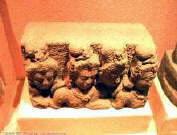
Lembah Bujang Archaeological Museum which displays artefacts including
pottery shards, ceramics and stoneware which dates back 1,500 years.
Chinese porcelain, stone carvings, Indian tridents and gemstones from
the Middle East are also among the objects displayed here.

The artefacts exhibited here are the results of years of archaeological
diggings and surveys carried out since 1845. Some 1,000 of these
artefacts are exhibited in the museum while another 2,500 artefacts are
still being studied. The numerous artefacts uncovered in the Bujang
Valley - celedon, porcelain, stoneware, clay, pottery, fragments of
glass, beads and Persian ceramics are exhibited here
 The
most well-known 'exhibit' at the museum is the Candi Bukit Batu Pahat.
It is believed to be built in the 17th Century on the summit of the
small hill behind the main building. It contains two principal parts -
the vimana or sanctuary, and the mandapa or hall. There are also statues
of Indian Gods and Goddesses, similar to those uncovered of historical
sites in India. The
most well-known 'exhibit' at the museum is the Candi Bukit Batu Pahat.
It is believed to be built in the 17th Century on the summit of the
small hill behind the main building. It contains two principal parts -
the vimana or sanctuary, and the mandapa or hall. There are also statues
of Indian Gods and Goddesses, similar to those uncovered of historical
sites in India.
Officially opened in 1980, the museum is surrounded by cool tropical
forests and the Batu Pahat Waterfall is an added attraction for those in
search of recreation and knowledge.
The Lembah Bujang Museum is open
daily from 8am through 4.15pm.
It closes from noon until 2.45pm on Fridays.
Entrance: Free
Location � Lembah Bujang, Merbok, Bedong
Visit Rating -

Kota Kuala Kedah
Kota Kuala Kedah also known as Kota Kuala Bahang is a fishing port,
situated by the estuary of a river about 12km to the west of Alor
Setar. Here lies the remains of an early Malay fort guarding Kedah
from early naval attacks, notably the Portuguese, the Acehnese from
Sumatra and the Bugis. It was rebuilt in 1771 but later a Siamese
fleet, on the pretext of a peaceful trading expedition attacked the
fort. Caught off guard, the people of Kedah were quickly overpowered
by the aggressors.

The fort�s plans was drawn by Sheikh Abd Jalil Mufti and includes a
moat surrounding the fort and a double brick wall standing 1.8m apart,
with the middle space fortified with packed earth. Within the fort,
there is a number of buildings including a royal audience hall. The
entire fort area was built on an area of about five acres. It was
reported that the stonemasons were specially brought in from India to
rebuild the fort and durable British cannons were installed, notably
named the Badak Berendam (the Wallowing Rhinocerous) and the Katak
Puru (the Toad) cannons. But in 1821, the fort was attacked and
conquered by the Thais nevertheless. The fort is surprisingly well
preserved and along the crumbling walls facing the river mouth, the
remnants of six cannons are still to be found.
Today, Kota Kuala Kedah is popular for the variety of seafood served
by the numerous restaurants in the fishing village. famous for its
�Laksa Kuala Kedah�, a local delicacy of thick rice vermicelli and
spicy fish gravy. Two floating seafood restaurants converted from
fishing vessels add to the town�s attraction. While enjoying the food,
one will be able to see six cannons still resting on the crumbling
walls, facing the river estuary.
Location � 12 km from Alor Setar
Visit Rating -

information - travel guide - places of interest |
|

